
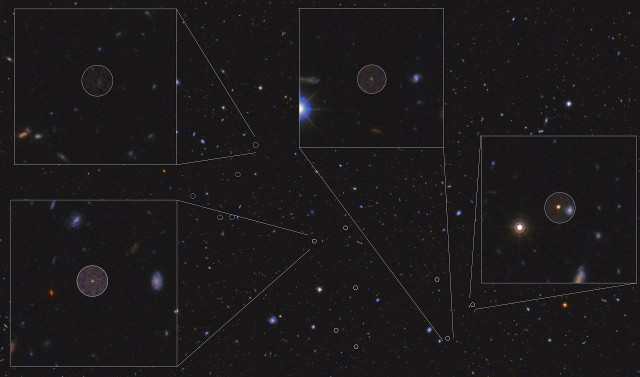
An article published in the journal “Monthly Notices of the Royal Astronomical Society” reports the discovery of the most densely populated galaxy cluster in formation in the early universe. A team of researchers used the OSIRIS instrument of the Gran Telescopio Canarias (GTC) to observe an area around the galaxy HDF850.1, already well known because it’s been the focus of various researches, discovering other protogalaxies. We see those galaxies as they were about 12.5 billion years ago, when the universe was very young, so this is a great discovery to study the birth and evolution of the largest structures in the universe.
This research represents the culmination of years of studies conducted by various research teams. It all started from the so-called Hubble Deep Field, the image of a region of space that showed, thanks to observations conducted with the Hubble Space Telescope, a considerable amount of hitherto unknown very distant galaxies.
An article published in June 2012 in the journal “Nature” reported a study focused on a particularly bright galaxy that was discovered in 1998 and cataloged as HDF850.1. It raised interest because it displayed extraordinary star-forming activity, the equivalent of a thousand new Suns every year, hundreds of times more than a normal galaxy such as the Milky Way. The study of HDF850.1 revealed an age of about 12.5 billion years and that it was part of a galaxy proto-cluster along with other primordial galaxies.
Now, a new study conducted using the OSIRIS (Optical System for Imaging and low Resolution Integrated Spectroscopy) instrument on the Gran Telescopio Canarias (GranTeCan or GTC) allowed to confirm 23 galaxies in the primordial cluster that includes HDF850.1, 10 more than the previous studies.
The image (Courtesy NASA/ESA/GOODS-N+3DHST+CANDELS Team/Daniel López/IACC) shows the cluster in formation that is the subject of this study. The insets show the details of four of the galaxies that are part of it.
The researchers also detected a remarkable density of the galaxies within that cluster, but there are more interesting data. Rosa Calvi, the first author of the article, explained that there was a surprise for the team when the observations showed that only the HDF850.1 galaxy had a very high star formation rate while it was at normal levels in the other galaxies in the cluster. The various galaxies are in various stages of their evolution, a very interesting discovery that can provide new information on the subject.
This galaxy cluster probably evolved into a structure comparable to that of the Virgo Cluster, the richest of those close to the so-called Local Group, about 60 million light-years from Earth with about 1,500 galaxies. The young cluster object of this study may have more galaxies than those already confirmed, as other candidates have been identified. It’s not easy to estimate the distances between galaxies billions of light-years from Earth, but the researchers intend to continue their studies.
