
An article published in “The Astrophysical Journal” reports a study on the variable star U Monocerotis conducted by examining data collected over almost 130 years. A team of researchers led by Laura Vega of Vanderbilt University in Nashville, USA, studied what is in fact a binary system using data that goes back to the observations conducted in 1888 and stored in the archives of the American Association of Variable Star Observers (AAVSO). This is the most comprehensive study ever conducted on a variable star, the largest of the pair, a yellow supergiant whose brightness varies over time.
About 3,600 light-years from Earth, the two stars of U Monocerotis orbit each other in about 6.5 years on a plane tipped about 75° from the line of sight on Earth. The yellow supergiant has a mass that is approximately twice the Sun’s but has a size that is approximately one hundred times that of the Sun. It’s an RV Tauri-class variable star, a so-called pulsating variable star.
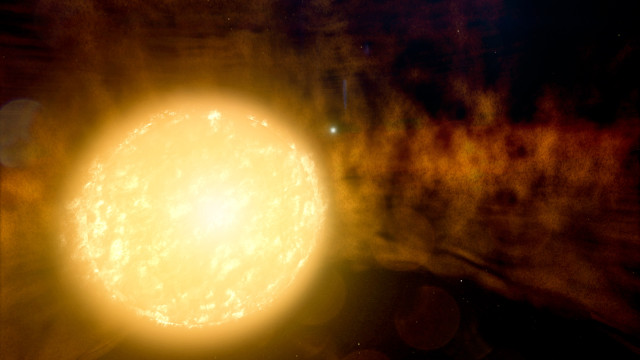
The image (NASA’s Goddard Space Flight Center/Chris Smith (USRA/GESTAR)) offers an artistic representation of U Monocerotis with the yellow supergiant in the foreground. In the background, there’s the companion, a little-known star that is probably a blue star of similar mass but much younger and with a normal size in relation to its mass.
The yellow supergiant is at the end of its normal life and will soon, in astronomical terms, shrink enormously and become a white dwarf. Changes are the main reason for its brightness variability. However, there’s also partial darkening due to a disk of dust surrounding it. The disk is probably composed of debris ejected by the yellow supergiant during its evolution. It increases the difficulty in observing the pair and is the reason why its companion is little known.
Laura Vega’s team put together old data collected in 1888 with other observations. They were conducted in various astronomical surveys ranging from the one archived in the Digital Access to a Sky Century @ Harvard (DASCH) from 1948 to the latest, obtained with ESA’s XMM-Newton space telescope in 2016, which detected X-ray emissions, the first coming from a variable of this type.
The amount of data collected over almost 130 years made it possible to reconstruct its cycles. The researchers found a cycle of about 60 years that could be due to a thickening of the disk’s materials at a distance comparable to that of Neptune from the Sun. They also estimated the diameter of the disk to be about 82 billion kilometers. The two stars orbit in a gap inside it.
In the field of astronomy, it’s normal to use old observations for new research, but the case of U Monocerotis is really extreme. The yellow supergiant represents a very interesting example of the final phase of the evolution of a not very massive star. Similarities with newly born binary systems were also noted due to the presence of gas and dust disks interacting with the stars. For these reasons, the studies of U Monocerotis will continue.
