Two articles – available here and here – published in the “Journal of Geophysical Research: Planets” report as many parts of a research on the interstellar asteroid ‘Oumuamua proposing the theory that it’s composed mainly of solid nitrogen and is a fragment of an exoplanet similar to Pluto. Professor Steven Desch and Dr. Alan Jackson of Arizona State University tried to evaluate the characteristics of different types of ice to see which one best matched the characteristics observed in ‘Oumuamua. Their conclusion is that nitrogen ice would explain this interstellar asteroid’s behavior. According to their reconstruction, between 400 and 500 million years ago, a collision detached a fragment from a planet similar to Pluto and launched it into interstellar space.
The discovery in October 2017 of the asteroid later formally classified as 1I/2017 U1 and named ‘Oumuamua sparked the interest of many astronomers after orbital calculations indicated it had come from interstellar space.
Various theories have been proposed to explain the composition of ‘Oumuamua and the anomalous behaviors that were detected. During the time it was visible from Earth, many astronomers tried to study it with various instruments. Unfortunately, this asteroid’s trajectory and speed limited the possibilities leaving many questions.
In particular, the data collected indicates that it entered the solar system at a slower speed than expected from an interstellar object, but subsequently had an acceleration that includes a thrust that no one convincingly explained because there was no cometary behavior with a release of gas and dust that could have justified it.
After some discussion, ‘Oumuamua has been cataloged as an asteroid but that doesn’t mean that it’s not composed at least partly of ice. The problem is figuring out which element or compound can form that ice. Steven Desch and Alan Jackson tried to examine the characteristics of different types of ice to try to understand if one of them could match ‘Oumuamua’s characteristics and behaviors. In their opinion, frozen nitrogen is the perfect answer.
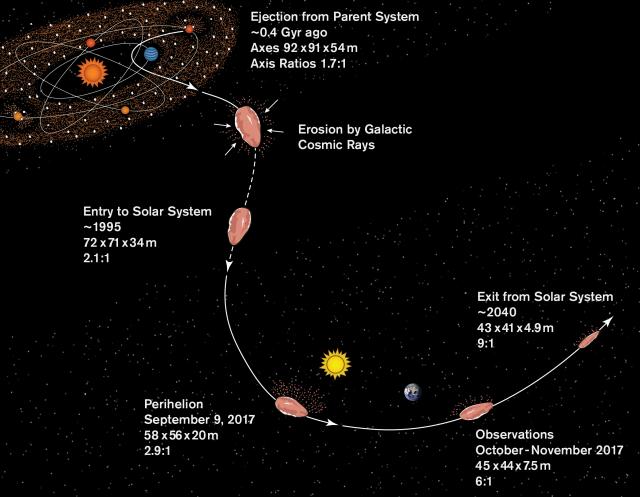
The study by Steven Desch and Alan Jackson calculated the effect of nitrogen sublimation, also to estimate the mass, shape, and reflectivity of ‘Oumuamua and according to them, the results match what was observed. In their reconstruction, the interstellar asteroid wasn’t flat when it entered the solar system but in the course of its journey around the Sun, it lost more than 95% of its mass. The sublimation of nitrogen ice would have resulted in the flattened shape of ‘Oumuamua like a bar of soap after long use.
The anomalous acceleration of ‘Oumuamua is more similar to that of a comet that receives a boost from the emissions of gas and various materials emitted due to the Sun’s influence. In the case of this interstellar object, no such emissions were detected but perhaps they were simply too limited to be detected from Earth. They’re emissions compatible with the presence of frozen nitrogen and its consequent sublimation.
When ‘Oumuamua entered the solar system, its speed was slower than expected from an interstellar object. According to the researchers, this suggests that it was ejected from its star system of origin between 400 and 500 million years ago. The bottom image (Courtesy S. Selkirk/ASU. All rights reserved) shows ‘Oumuamua’s possible history.
If indeed ‘Oumuamua is composed mostly of frozen nitrogen, it’s plausible that it was detached from a Pluto-like exoplanet following a collision. From Earth, it’s really difficult to locate an exoplanet small and far from its star, and this interstellar asteroid could be the first evidence of the existence of an exo-Pluto.
Certainly, the discussions on the interstellar asteroid ‘Oumuamua will continue. At the same time, the search for other interstellar objects that can provide us with new information on the history of other star systems will continue as well.