
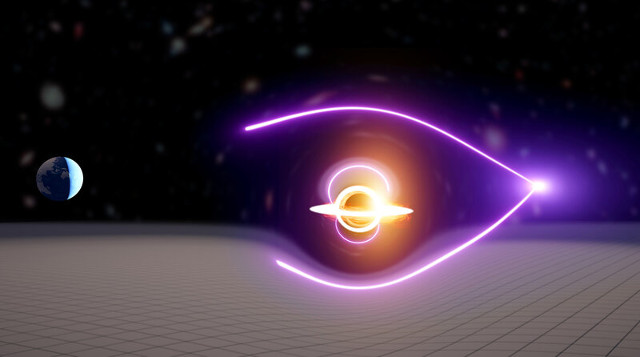
An article published in the journal “Nature Astronomy” reports the discovery of a candidate intermediate-mass black hole. A team of researchers studied a gravitational lens using detections of photons that were part of a gamma-ray burst to calculate the mass of the lens based on the delay caused by the deviation of the photons of its “echo”. The result is that the mass of the object acting as a gravitational lens was estimated to be about 55,000 times the Sun’s. The nature of the object is not certain but the analysis of the data clearly favors the hypothesis that it’s an intermediate-mass black hole, a type of black hole that is rare and, above all, very elusive.
Astronomers James Paynter, Rachel Webster, and Eric Thrane tried to search for traces of intermediate-mass black holes by exploiting their possible gravitational lensing effects on gamma-ray burst emissions. The mass of an intermediate-mass black hole, between 100 and 100,000 times the Sun’s, can be sufficient to generate a gravitational lens and therefore to bend the light passing near it. Data for 2,700 gamma-ray bursts detected by NASA’s Compton Gamma Ray Observatory’s BATSE (Burst & Transient Source Experiment) instrument was examined by the three astronomers for this purpose.
The search was successful with the analysis of data about the gamma-ray burst cataloged as GRB 950830, detected on August 30, 1995. A part of the photons emitted by that gamma-ray burst arrived with a delay of about 390 milliseconds, a sort of echo. That’s normal when electromagnetic emissions are partially deflected by a gravitational lens. The researchers calculated the characteristics of the space distortion is needed to generate that delay and found that the object must have a mass about 55,000 times the Sun’s, the mass of an intermediate-mass black hole.
This type of black hole could be a primordial object created when the universe was very young, before the formation of the first stars and galaxies. It could be a “seed” of a supermassive black hole that over time acquires mass by swallowing surrounding materials until it becomes millions of times more massive than the Sun. So far, these are theoretical studies because intermediate-mass black holes seem almost impossible to be found, therefore this study offers interesting new possibilities.
The researchers estimated that there could be 46,000 intermediate-mass black holes in and near the Milky Way. Again, these are theoretical calculations and it’s not even certain that the object that deflected the emissions of the gamma-ray burst GRB 950830 is of that type. The probabilities definitely favor this interpretation, but the uncertainty proves once again how difficult it is to identify these invisible objects. It’s one of the frontiers of astronomy, and studies in recent years are helping to better understand and find these extreme objects, also to assess the influence they have on the galaxies that host them.
