March 2021

Different values of the Hubble constant

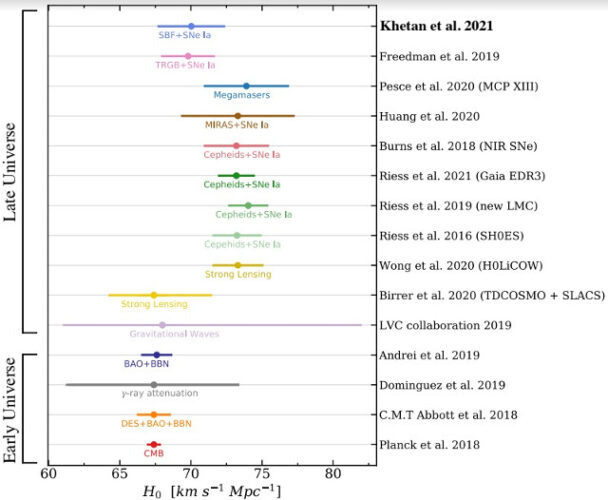
An article published in the journal “Astronomy & Astrophysics” reports a method to measure the expansion velocity of the universe that takes into account the differences between the type Ia supernovae used. A team of researchers led by Nandita Khetan, Ph.D. student at the Italian Gran Sasso Science Institute and associated with the Italian National Institute of Nuclear Physics, proposed a method to calibrate the distances of those supernovae using the surface brightness fluctuations (SBF) of their host galaxies. The result is closer to the ones already calculated with other methods than the one obtained without that calibration. It doesn’t solve the problem of very different values ​​of the so-called Hubble constant but suggests the possibility that the problem is due to instrumental inaccuracies and doesn’t require new physics.

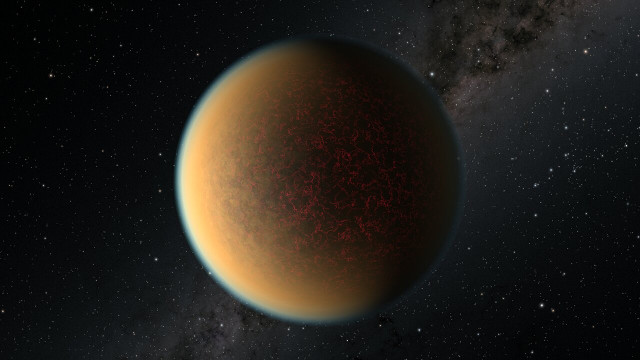
An artist’s impression of the exoplanet GJ 1132 b (Image NASA, ESA, and R. Hurt (IPAC/Caltech))

An article to be published in “The Astronomical Journal” reports a study on the atmosphere of the exoplanet GJ 1132 b which indicates that it may have lost its original atmosphere and that a new one was subsequently formed as a result of volcanic activity. A team of researchers led by Mark Swain of NASA’s Jet Propulsion Laboratory used observations conducted with the Hubble Space Telescope to detect the presence of an atmosphere containing hydrogen, hydrogen cyanide, methane, and ammonia with hydrocarbon hazes. According to the researchers, GJ 1132 b may have originated as a sub-Neptune, lost its original atmosphere because it’s very close to its star and therefore very hot, and what is now being detected is a new atmosphere generated by volcanic activity.

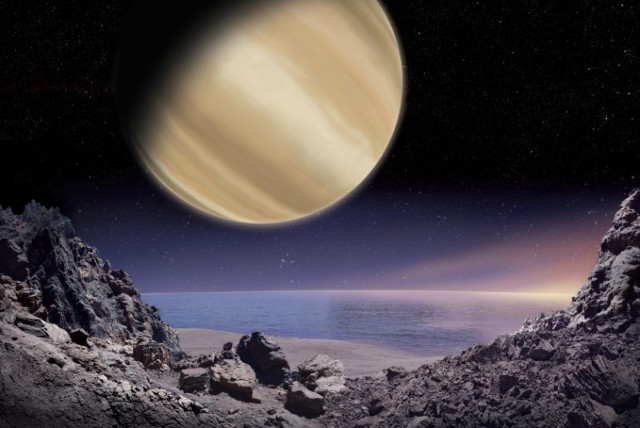
Artist's concept of Planet Pirx seen from a possible moon (Image courtesy M. Mizera / Pta / Iau100)

An article published in the journal “Astronomy and Astrophysics” reports the discovery of 26 planetary systems within the TAPAS (Tracking Advanced Planetary Systems) project. A team of researchers led by Professor Andrzej Niedzielski of the Institute of Astronomy at the NCU (Nicolaus Copernicus University) in Torun, Poland, used over a decade of observations with the Hobby-Eberly Telescope and the Galileo National Telescope to locate the traces of exoplanets around old stars, mostly now red giants, the last phase of their life. For their masses very similar to the Sun’s, three stars in particular have been defined as the Sun’s elder sisters.

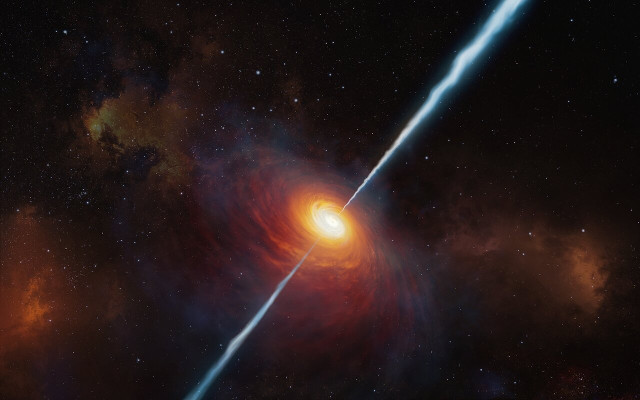
Artist's representation of P172+18 (Image ESO/M. Kornmesser)

An article published in “The Astrophysical Journal” reports the discovery of the farthest radio-loud quasar. A team of researchers led by Chiara Mazzucchelli, a Fellow at ESO in Chile, and Eduardo Bañados of the Max Planck Institute for Astronomy used various telescopes to identify the quasar cataloged as PSO J172.3556+18.7734 and simply called P172+18. This quasar is about 13 billion years old and that means we see it as it was when the universe was very young, less than 800 million years after the Big Bang. It can offer new insights into the primordial universe and the objects its emissions passed through to reach Earth.

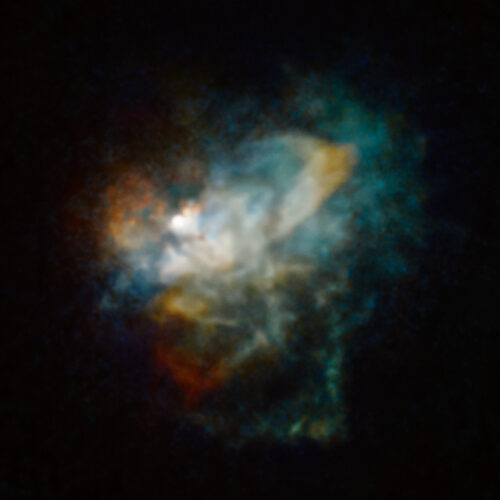
The nebula surrounding VY Canis Majoris seen by Hubble (Image NASA, ESA, and R. Humphreys (University of Minnesota), and J. Olmsted (STScI))

An article published in “The Astronomical Journal” reports a study on the dimming of the red hypergiant star VY Canis Majoris. A team of researchers led by astrophysicist Roberta Humphreys of the University of Minnesota, USA, used observations conducted with the Hubble Space Telescope to study not only the star but also huge clumps of materials around it. The conclusion is that VY Canis Majoris had moments where it ejected huge amounts of materials that formed those clumps and obscured it for various periods, detected over time.