April 2021

The Ingenuity helicopter's shadow (Photo NASA/JPL-Caltech)

Yesterday, the Ingenuity helicopter conducted its first flight on planet Mars. The duration was only 40 seconds and it reached an altitude of just over 3 meters but it was important to lift off the ground this drone built to test the technologies needed to fly a vehicle in the Martian atmosphere, which is very thin. The flight was autonomous, pre-scheduled, and initiated by a command launched from Earth. The images, along with telemetry data, were transmitted to the Mars Rover Perseverance mission control center.

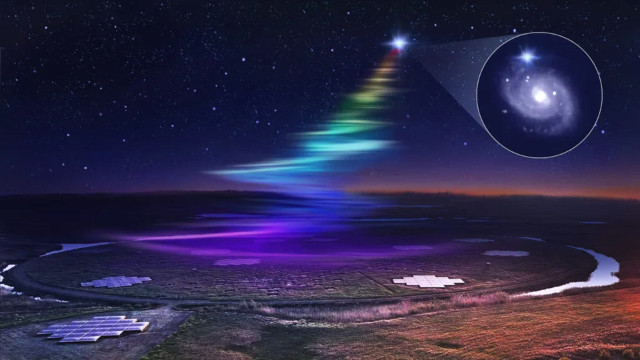
Artistic concept of the LOFAR radio telescope and fast radio burst FRB 20180916B (Image courtesy D. Futselaar / S.P. Tendulkar / ASTRON)

Two articles, one published in “The Astrophysical Journal Letters” and one published in “Nature Astronomy”, report various aspects of a research on the fast radio burst FRB 20180916B, whose emissions include the lowest frequencies at which such an event has been detected so far. Two teams of researchers with various members in common used detections obtained with the LOFAR radio telescope and the European VLBI network to study this fast radio burst that is repeating with a periodicity of just over 16 days. Its origin has been pinpointed in a small region around a neutron star.

Kate Rubins, Sergey Ryzhikov, Sergey Kud-Sverchkov, and the crew that assisted them after their landing (Photo NASA/Bill Ingalls)

A few hours ago, astronaut Kate Rubins and cosmonauts Sergey Ryzhikov and Sergey Kud-Sverchkov returned to Earth on the Soyuz MS-17 spacecraft, that landed in Kazakhstan. The three of them spent a bit more than 6 months on the International Space Station, where they arrived on October 20, 2020, as part of Expedition 63. After landing, they were assisted by a skeleton crew with the precautions needed to avoid the risk of Covid-19 infection.

The area around the supermassive black hole at the center of the galaxy M87 seen in the various bands of the electromagnetic spectrum during the 2017 observation campaign

An article published in “The Astrophysical Journal Letters” reports the results of multiband observations of the area around the supermassive black hole at the center of the galaxy M87. 33 members of the Multiwavelength Science Working Group of the Event Horizon Telescope (EHT) led a large team of researchers who put together data collected by the various radio telescopes that made up the EHT in the extraordinary campaign of observations which led to the historical photo published in 2019 and other data of observations in other electromagnetic bands conducted with various space and ground-based telescopes. This allows to conduct more in-depth analyzes thanks to the completeness of the emissions detected not only by the supermassive black hole but also by its jets that eject materials at very high speeds.

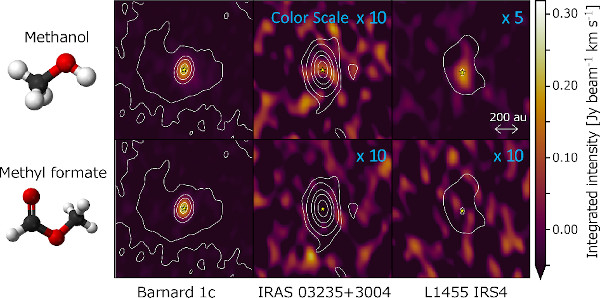
Distribution of molecular gas around some observed protostars in the Perseus Molecular Cloud

An article published in “The Astrophysical Journal” reports a study of organic molecules detected in 50 regions of protoplanetary disk formation in the Perseus Molecular Cloud. A team of researchers coordinated by the RIKEN Cluster for Pioneering Research used the ALMA radio telescope to detect the various molecules present in that molecular cloud, discovering that the distribution of complex organic molecules varies greatly in different areas. The composition was similar in young protoplanetary disks.