
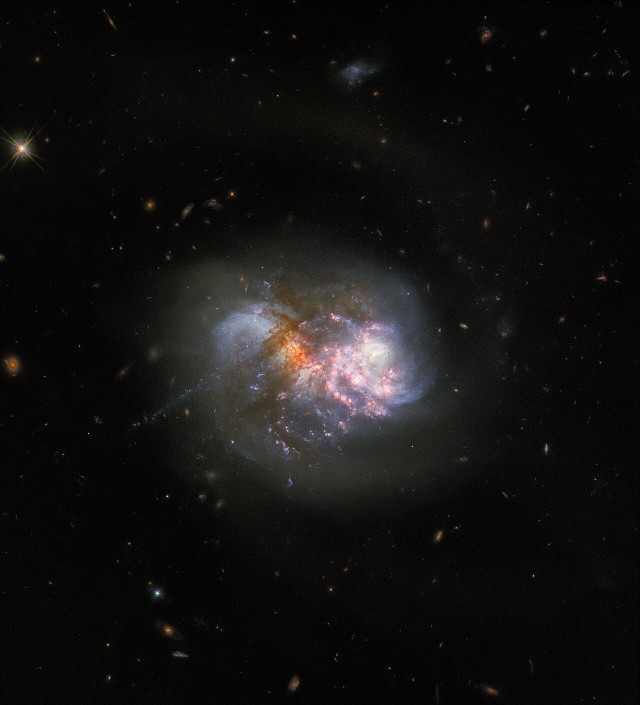
A new image captured by the Hubble Space Telescope shows a pair of galaxies in an advanced phase of merger cataloged as IC 1623. The filters used for the Wide Field Camera 3 (WFC3) instrument that captured the image allow seeing the differences between the two galaxies that are merging. This process can still continue for millions of years, so it will take who knows how long before a new galaxy is formed. Meanwhile, astronomers expect gas pushed by gravitational interactions to trigger a new star formation in what will subsequently be referred to as a starburst galaxy.
About 275 million light-years from Earth, IC 1623 is also known by other designations depending on the reference catalog. A pair of interacting galaxies, in this case in an advanced merger stage, is always interesting for astronomers because it allows them to observe the consequences of those interactions.
In a few billion years, the Milky Way and Andromeda will also merge and IC 1623 could provide some sort of preview of that event. Actually, each merger is different because the effects depend on the position that the two galaxies have relative to each other in the three spatial dimensions. For this reason, every pair discovered is the subject of specific studies.
The IC 1623 pair has already been studied in the past with the Hubble Space Telescope as well. In 2008, an image was captured using the Advanced Camera for Surveys (ACS) instrument with two optical and infrared wavelength filters. The new image offers much more thanks to the eight filters ranging from infrared to ultraviolet wavelengths used by the WFC3 instrument.
The distances between the stars of a galaxy are enormous, making star collisions during a merger unlikely. The situation is different for the supermassive black holes that were probably at the center of the two original galaxies: they have such a gravity force that they tend to attract each other and will probably merge in several million years from our point of view.
The observations of IC 1623 show that one of the two merging galaxies contains a significant amount of dense gas, also present in the area that already connects the two galactic nuclei. In galaxy mergers, it’s normal for gas clouds to be subjected to gravitational shocks that trigger the birth of new stars at a rate that can be very high for a few million years. That’s one of the most interesting processes for astronomers.
The observations of the processes taking place within IC 1623 and in particular star formation will continue to be studied. New advances in understanding those processes could come thanks to the James Webb Space Telescope, whose launch, unfortunately, continues to be delayed. It’s a case where it’s fortunate that these processes are so slow from a human point of view.
