August 2021

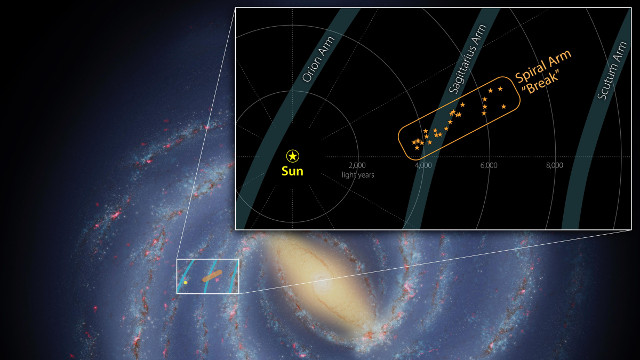
A reconstruction of the Milky Way, the Sagittarius Arm and its "splinter"

An article published in the journal “Astronomy & Astrophysics” reports the discovery of an anomalous structure in the Milky Way’s Sagittarius Arm. A team of researchers used observations made with NASA’s Spitzer Space Telescope and data collected by ESA’s Gaia space probe to locate a structure about 3,000 light-years long that has an orientation that’s very different from the rest of the Sagittarius Arm. Such structures have been identified in other galaxies but it’s the first time that one of them has been identified within the Milky Way. That’s not a surprise, as it’s difficult to study such large structures of the galaxy from the inside.

The galaxy Hercules A

A series of ten articles to be published in the journal “Astronomy & Astrophysics” reports the results of the activity of the LoFar network with its 70,000 antennas with unprecedented details of various galaxies at radio frequencies. A team of astronomers has published these results consisting of astronomical images obtained by making the most of the LoFar network’s capabilities. This made it possible to obtain images twenty times sharper than the previous ones generated by LoFar.

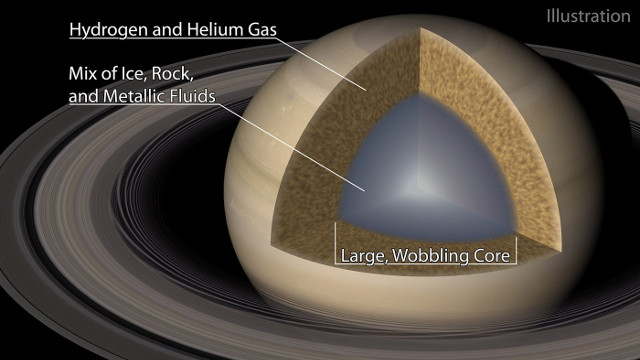
The possible structure of Saturn (Image courtesy Caltech/R. Hurt (IPAC))

An article published in the journal “Nature Astronomy” reports a study on the planet Saturn’s core. Caltech astronomers Christopher Mankovich and Jim Fuller analyzed data collected by the Cassini space probe on the oscillations of Saturn’s rings caused by the internal seismic activity to indirectly analyze the characteristics of the planet’s interior. The conclusion is that the core is not rocky but a mixture that has been compared to a soup or a sludge composed of ice, rock, and metallic fluids that fill a volume for about 60% of Saturn’s diameter, far more than it was previously estimated.

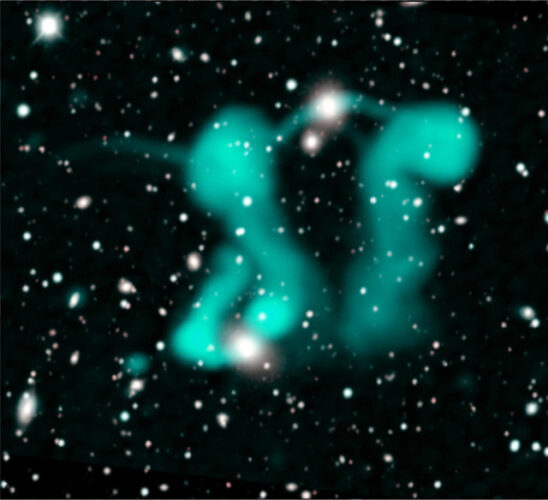
The dancing ghosts seen by ASKAP

An article accepted for publication in the journal “Publications of the Astronomical Society of Australia” reports the first results of the EMU (Evolutionary Map of the Universe) survey, which allowed to discover several objects and phenomena. One of those phenomena is made by strange clouds of electrons surrounding two galaxies about a billion light-years from Earth. This survey was conducted using the ASKAP radio telescope and led to the cataloging of about 220,000 sources including the electron clouds that were compared to dancing ghosts due to their curious shape.

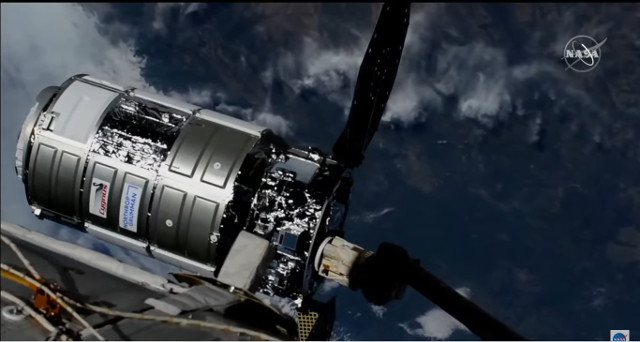
The Cygnus S.S. Ellison Onizuka captured by the Canadarm2 robotic arm (Image NASA TV)

Northrop Grumman’s Cygnus spacecraft, launched last Tuesday, August 10, has just reached the International Space Station and was captured by the Canadarm2 robotic arm. Astronaut Megan McArthur, assisted by her colleague Thomas Pesquet, will soon begin the slow maneuver to move the Cygnus until it docks with the Station’s Unity module after about two hours.