August 2021

The Cygnus S.S. Ellison Onizuka cargo spacecraft blasting off atop an Antares rocket (Photo NASA’s Wallops Flight Facility/Jamie Adkins)

A few hours ago, Northrop Grumman’s Cygnus spacecraft blasted off atop an Antares rocket from the Mid-Atlantic Regional Spaceport (MARS), part of NASA’s Wallops Flight Facility (WFF) on Wallops Island. After about nine minutes it successfully separated from the rocket’s last stage went en route to its destination. This is its 16th official mission, called NG-16 or CRS NG-16, to transport supplies to the International Space Station for NASA.

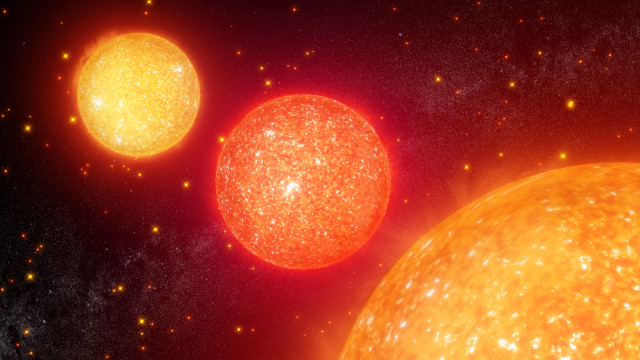
Artist's concept of red giants (Image NASA’s Goddard Space Flight Center/Chris Smith (KBRwyle))

An article accepted for publication in “The Astrophysical Journal” reports the discovery of a total of 158,505 pulsating red giants. A team of researchers used the map of most of the sky created thanks to NASA’s TESS space telescope and, taking advantage of the quality of those observations, identified an unprecedented amount of this type of stars. The map analysis was conducted using a machine learning system trained to detect the traces of the oscillations in the stellar spectra of red giants. This is a very useful result for the studies of astroseismology, a branch of astronomy that studies the structure and properties of stars by analyzing their pulsations. Marc Hon of the University of Hawaii presented the results at the second TESS Science Conference, held virtually in recent days.

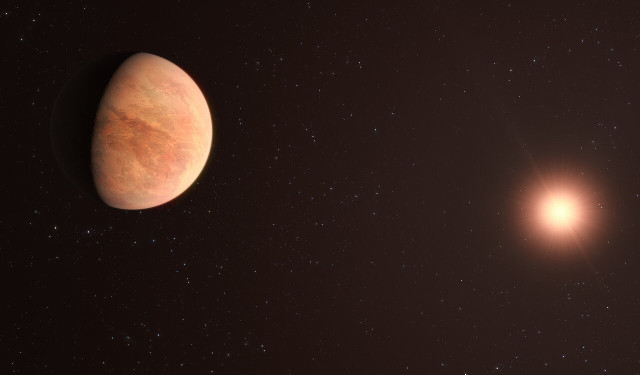
Artist's concept of the exoplanet L 98-59b and its star (Image ESO/M. Kornmesser)

An article published in the journal “Astronomy & Astrophysics” reports a study on the planets orbiting the red dwarf star L 98-59. A team of researchers used the ESPRESSO instrument mounted on ESO’s VLT in Chile to study the characteristics of three already known exoplanets and concluded that the innermost one has a mass that is approximately half of Venus’s. There was some doubt about the nature of the outermost planet, and this study suggests that it’s a rocky planet that contains a large amount of water. The researchers found evidence of a fourth planet and clues that there might be a fifth planet.

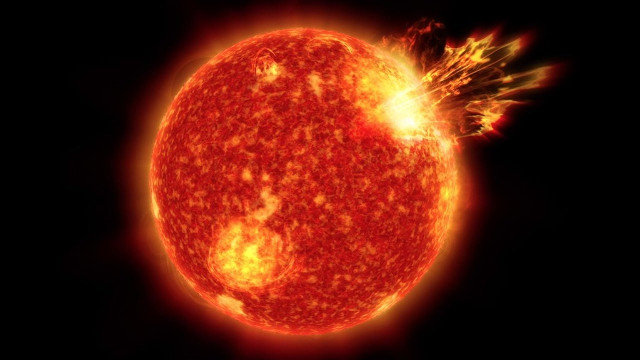
Artist's concept of what the Sun looked like 4 billion years ago (Image NASA's Goddard Space Flight Center/Conceptual Image Lab)

An article published in “The Astrophysical Journal” reports a study on the star Kappa 1 Ceti, very similar to the Sun in size and mass but much younger having an estimated age between 600 and 750 million years. A team of researchers coordinated by NASA’s Goddard Space Flight Center predicted some hard-to-measure features of Kappa 1 Ceti using computer models based on data collected by various NASA and ESA space telescopes. The results help to understand what the Sun looked like nearly four billion years ago, when it could emit superflares, to reconstruct the influence of its activity on early Earth and early life.

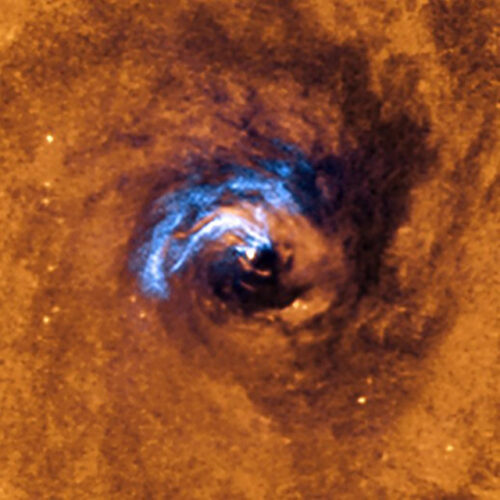
The process that was called nuclear feeding of the galaxy NGC 1566's supermassive black hole

An article published in the journal “Monthly Notices of the Royal Astronomical Society” reports a study on the feeding process of the supermassive black hole at the center of the galaxy NGC 1566. A team of researchers led by Almudena Prieto of the Instituto de Astrofísica de Canarias (IAC) used observations conducted with the Hubble Space Telescope, the VLT, and the ALMA radio telescope in Chile to be able to visualize filaments of interstellar dust that separate and subsequently head towards the supermassive black hole, approaching it in a spiral trajectory that eventually leads them to be swallowed. Those filaments could obscure the center of many galaxies with active galactic nuclei.