September 2021

Artistic illustration comparing the sizes of Earth, TOI-1634b, and TOI-1685b

An article published in “The Astronomical Journal” reports a study on two “bare” super-Earths, as they lack a primordial atmosphere. A team of researchers used the Subaru telescope and other instruments for a follow-up study of two candidate exoplanets discovered by NASA’s TESS space telescope and classified as TOI-1634b and TOI-1685b. Both candidates were confirmed and showed some characteristics in common since they’re super-Earths with orbits that are very close to their stars, both red dwarfs, with no primordial atmosphere. Their study will help to understand the evolution of the atmospheres of hot rocky planets.

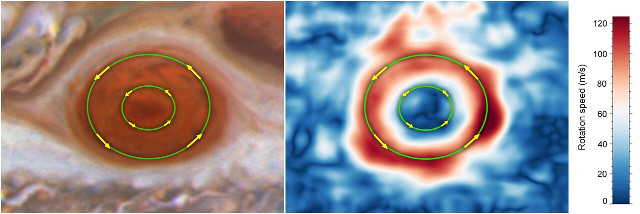
The Great Red Spot with green circles indicating the areas where changes in wind speeds have been detected

An article published in the journal “Geophysical Research Letters” reports a study on the changes that occurred in the winds present in the famous Great Red Spot on the planet Jupiter. A team of researchers analyzed observations conducted with the Hubble Space Telescope between 2009 and 2020 to conclude that the winds in the outer zone of the Great Red Spot are accelerating. On the contrary, the winds near the innermost region of the colossal Jovian storm are slowing down.

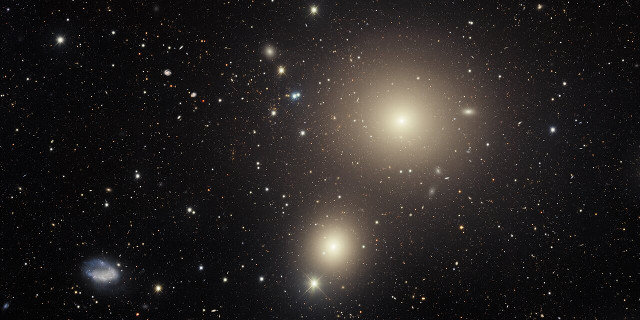
Some of the galaxies in the Fornax Cluster seen by the DECam

An image captured by the Dark Energy Camera (DECam) shows some galaxies in the Fornax Cluster. The galaxies NGC 1399 and NGC 1404 are two of the brightest in the cluster and their gravity is bringing them closer to the point that there may already be interactions. The irregular dwarf galaxy NGC 1427A, in the left corner in the top image, is suffering even more from the cluster’s gravitational pull and is moving towards its core. According to astronomers, it will eventually be destroyed in the distant future millions of years.

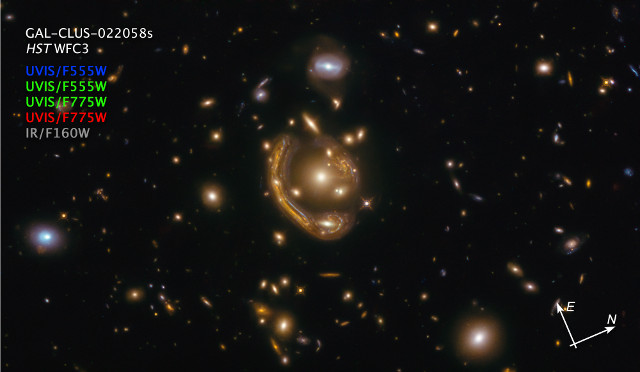
The Molten Ring seen by Hubble (Image Anastasio Díaz-Sánchez (Universidad Politécnica de Cartagena))

An article published in “The Astrophysical Journal” reports a study on the Einstein ring nicknamed the Molten Ring for its “liquid” appearance and because it was identified in the constellation of the Furnace. A team of researchers used observations made with the Hubble Space Telescope and the FORS 2 instrument on the VLT in Chile of the object formally classified as GAL-CLUS-022058s to study its physical characteristics. The ring is actually a galaxy whose light has been distorted by a gravitational lens and, according to the study’s conclusions, is about 9.4 billion light-years away from Earth.

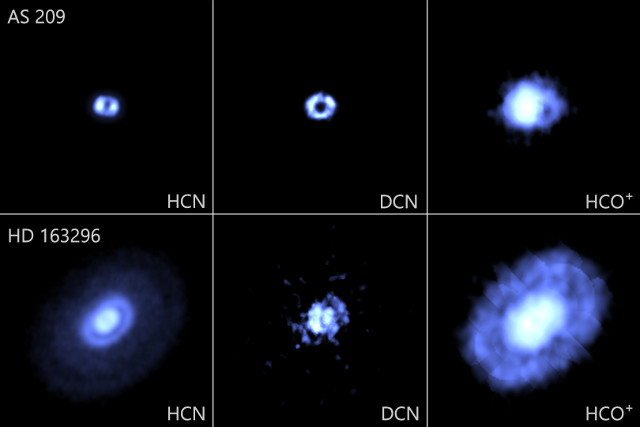
Molecules mapped in the protoplanetary disks around the stars AS 209 and HD 163296

A series of articles published in the “Astrophysical Journal Supplement Series” reports the detection of organic molecules potentially important for the birth of life forms in some protoplanetary disks. A team of researchers used the ALMA radio telescope as part of the MAPS program. ALMA made it possible to detect the emissions of molecules such as cyanoacetylene, acetonitrile, and cyclopropenylidene in the disks of young stars IM Lupi, GM Aurigae, AS 209, HD 163296, and MWC 480. These organic compounds are precursors of more complex molecules important in biological processes and some of them are similar to those that formed in the solar system.