
An article published in “The Astrophysical Journal Letters” reports a study on the brown dwarf classified as WISEA J153429.75-104303.3, or simply WISE 1534–1043, nicknamed the Accident because it was discovered purely by chance. A team of researchers used observations conducted with various telescopes to try to understand the characteristics of a brown dwarf different from the ones already known. Its emissions are very dim making it difficult to obtain the desired information but the researchers’ conclusion is that it’s very old, with an age between 10 and 13 billion years, and passed close to much more massive objects that accelerated it until reaching the remarkable speed detected. Its relative proximity to Earth could be random or indicate that brown dwarfs of that type are more common than expected but we can’t detect them with current instruments.
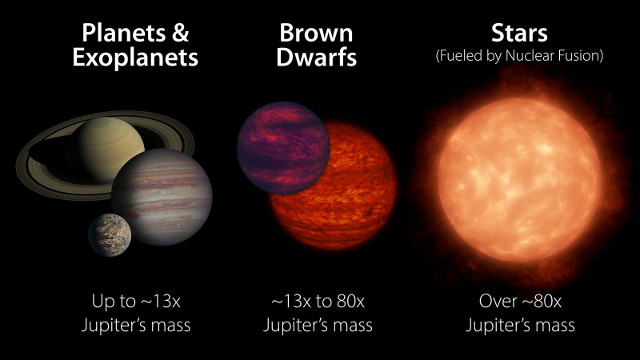
Brown dwarfs have been known for a little over twenty years, although their existence was theorized much earlier. They’re called failed stars because their mass is not enough to trigger hydrogen fusion. The consequence is that they have very low electromagnetic emissions which make it difficult to identify them when they’re not companions of normal stars and even more to study their characteristics. The infographic (NASA/JPL-Caltech) offers a comparison of the sizes of planets, brown dwarfs, and very small stars.
The Accident owes its nickname to the fact that no astronomer had realized that it was detected by NASA’s WISE Space Telescope during its NEOWISE mission due to its very dim emissions. Only when citizen scientist Dan Caselden examined those observations searching for brown dwarfs did he discover it, and this led to its identification and official designation.
The first observations were really strange because the Accident is really dim at some wavelengths, which suggests it’s a very cold and therefore very old brown dwarf, but it’s far brighter at other wavelengths suggesting a higher temperature.
To try to solve the mystery, more observations were conducted at the Keck Observatory in Hawaii at other infrared frequencies. As a result, the Accident was too dim at those frequencies to be detected and this seemed to confirm its remarkable age.
One possibility investigated by the researchers was that the Accident was farther away than estimated. However, the estimates obtained thanks to observations conducted with the Hubble and Spitzer space telescopes led to rule out that hypothesis, confirming that this brown dwarf is about 50 light-years from Earth. The data collected also made it possible to measure its truly remarkable speed given that it was estimated at around 800,000 km/h.
An explanation for the strange luminosity profile of the Accident came by examining its composition, which is very low in carbon and consequently very low in methane. Typically, even very cold brown dwarfs contain some amount of methane, which absorbs the infrared frequencies at which the Accident is bright. This confirms that it’s a very ancient brown dwarf, estimated to be between 10 and 13 billion years old. That age means that it formed when the Milky Way was young and its stars hadn’t formed and shed much carbon yet. This explains why it’s composed almost only of hydrogen and helium.
The existence of such ancient brown dwarfs is no surprise but finding one in the cosmic neighborhood is unexpected because they’re considered very rare. Perhaps it was a stroke of luck that the Accident is passing so close to Earth but it’s possible that there are more ancient brown dwarfs than expected that are not detected because their emissions are too weak.
The discovery of the Accident and the difficulties in its study show the limitations of current instruments. Brown dwarfs still remain quite mysterious but research continues to find more of them. Their study will help to better understand the formation and evolution of stars and planets as well.
