September 2021

The launch of the Tianzhou 3 cargo spacecraft (Photo courtesy CASC)

Yesterday, the Chinese cargo spacecraft Tianzhou 3 reached the Chinese space station’s Tianhe core module. It was launched about 6.5 hours earlier on a Long March-7 Y4 rocket from the Wenchang base. This is the second cargo spacecraft launched to the new Chinese space station and carries propellant along with supplies of various kinds for the taikonauts, as the Chinese call their astronauts, who will arrive in October.

The Crew Dragon Resilience spacecraft splashing down (Photo courtesy Inspiration4 / SpaceX)

A few hours ago, SpaceX’s Crew Dragon Resilience spacecraft concluded its Inspiration4 mission splashing down without problems. Onboard were Jared Isaacman, Sian Proctor, Hayley Arceneaux, and Chris Sembroski, who finished the first completely private space mission in the Atlantic Ocean not far from Cape Canaveral. Shortly after the splashdown, the SpaceX ship called “Go Searcher” went to retrieve the Crew Dragon and its crew to transport them to the coast.

The Shenzhou 12 capsule after landing (Photo courtesy Xinhua/Ren Junchuan)

A few hours ago, the three Chinese taikonauts of the Shenzhou 12 mission returned to Earth after spending about three months on the Chinese space station’s Tianhe core module. Nie Haisheng, Liu Boming, and Tang Hongbo had left Tianhe about a day earlier to land at a site called Dongfeng in China’s Inner Mongolia Autonomous Region. It was the longest Chinese space mission completed so far but the next missions to the Chinese space station are expected to last six months.

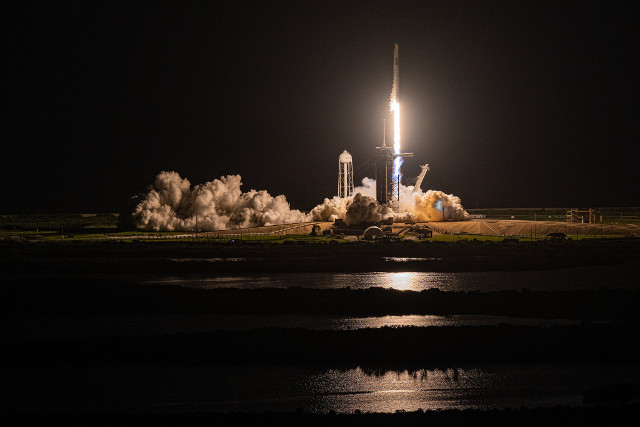
The Crew Dragon Resilience spacecraft blasting off in the Inspiration4 mission (Photo courtesy Inspiration4 / John Kraus)

A few hours ago, SpaceX’s Crew Dragon Resilience spacecraft blasted off atop a Falcon 9 rocket from the Kennedy Space Center in the Inspiration4 mission. After about eleven minutes it successfully separated from the rocket’s last stage. It will spend three days in orbit for the first completely private crewed space mission. It opens a further frontier for space tourism but is also linked to a charity campaign for the American St. Jude hospital in Memphis.

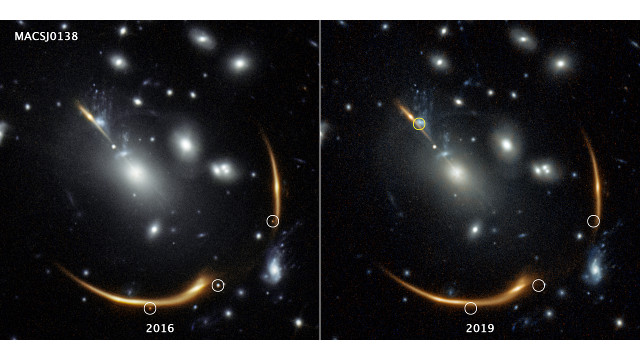
The galaxy cluster MACS J0138.0-2155 and the Requiem supernova

An article published in the journal “Nature Astronomy” reports a study on a supernova whose glow was distorted and multiplied by a gravitational lens. A team of researchers examined various images captured over the years by the Hubble Space Telescope after three images of the supernova AT 2016jka, dubbed Requiem, were discovered in 2016 archival data. As it’s normal, its brightness faded away until it disappeared but, according to the researchers, a fourth image of that supernova will be visible in 2037, again due to the distortion generated by the gravitational lens produced by the force of gravity of the galaxy cluster MACS J0138.0-2155, or simply MACS J0138.