
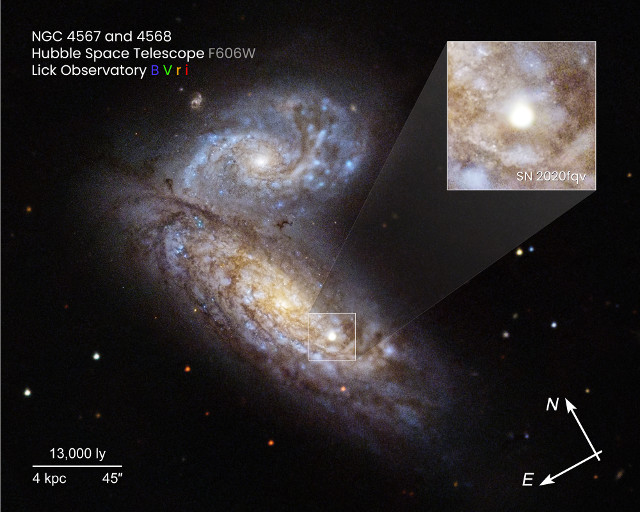
An article to be published in the journal “Monthly Notices of the Royal Astronomical Society” reports observations of a supernova that was cataloged as SN 2020fqv in the galaxy NGC 4568. A team of researchers used the Hubble Space Telescope combining data collected with other instruments to study this supernova starting from the first moments of the explosion. Information on the last moments of the progenitor star’s life, on the materials very close to the supernova ejected from the star in the last year of its life, and on the first phase of the supernova will help find the signs of other upcoming supernovae.
About 60 million light-years from Earth, the galaxy NGC 4568 forms a pair of interacting galaxies that are getting closer to each other with the neighboring NGC 4567. This is the first phase of a galaxy merger, and for the combined form the pair have been nicknamed “butterfly galaxies” or “Siamese twins”.
On April 1, 2020, the supernova SN 2020fqv was detected by the Palomar Observatory in San Diego. At that time, NASA’s TESS space telescope was monitoring a sector that includes the galaxy NGC 4568: it’s a planet hunter but on April 1, 2020, it detected the supernova as well.
Special systems alert the astronomical world in case of events such as supernovae to allow observations to be conducted as soon as possible with other instruments. In the supernova SN 2020fqv’s case, it was also possible to conduct observations with the Hubble Space Telescope a few hours after the alert. These are valuable observations for obtaining data on the very first phase of the supernova.
Other telescopes were used to observe the supernova SN 2020fqv and offered more information. The image (Ryan Foley (UC Santa Cruz)) shows the galaxies NGC 4567 (top) and NGC 4568 (bottom) in a composition that combines observations from the Hubble Space Telescope with others from the Lick Observatory. The supernova SN 2020fqv is shown in the inset.
The investigation also concerned the progenitor star because it’s important to understand its characteristics in the study of the supernova. The Hubble, with archival images dating back to the 1990s, and TESS, with images of the space sector that started several days before the supernova and continued for several weeks, space telescopes were useful again.
Three different methods were employed to estimate the mass of the progenitor star and gave consistent results with a probable mass between 14 and 15 times the Sun’s. This is an important piece of the history of the supernova SN 2020fqv that helps to understand the processes leading to the death of massive stars.
For the amount of data collected, SN 2020fqv was called the Rosetta stone of supernovae by Ryan Foley of the University of California, Santa Cruz, who led the team that discovered this supernova, and by Samaporn Tinyanont of the same university, the lead author of the article. In particular, the two researchers mentioned the unprecedented observations of the region closest to the star that exploded.
The reconstruction of events from the period leading up to the supernova SN 2020fqv could offer the possibility of recognizing the signs of other impending explosions. An early alert system would help to study supernovae even better, catastrophic events and at the same time crucial in the evolution of new star systems since they generate new elements heavier than hydrogen and helium, including the ones necessary for life forms such as the ones on Earth.
