
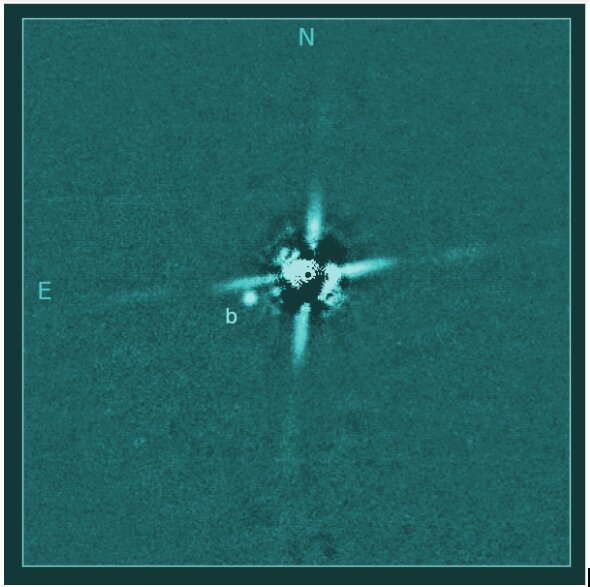
An article published in the journal “Monthly Notices of the Royal Astronomical Society” reports the discovery of a newborn planet orbiting the red dwarf star 2M0437. A team coordinated by the University of Hawaii at Mānoa used various telescopes to confirm that the discovered object was a planet orbiting that star and to capture a direct image of it. 2M0437b is one of the youngest exoplanets discovered so far, born together with its star in the Taurus Cloud, a stellar nursery that has been the subject of various astronomical studies.
The discovery of the exoplanet 2M0437b happened in 2018 thanks to the Subaru telescope but it took a long time to verify its nature. That’s because its distance from its star is about 100 times that of the Earth from the Sun and therefore it orbits very slowly around it. The star also moves slowly in the sky but over the course of many months, it was possible to verify that the planet moved with it.
The star 2M0437 has an age that has been estimated at 2.5 million years and a distance from Earth estimated at 420 light-years. It has a mass that is only between 15% and 18% of the Sun’s while the planet discovered around it has an estimated mass between 3 and 5 times Jupiter’s. This combination is anomalous given that such a massive planet takes a long time to form by accretion but in the case of formation due to the protoplanetary disk instability, the total mass in the system should be such to generate a much bigger star.
The combination of the relatively short distance of the exoplanet 2M0437b from Earth and the relatively large distance from its star made it easier to capture a direct image (Courtesy Subaru Telescope and Gaidos, et al. All rights reserved). The instruments used were exploited to study its characteristics, and Professor Eric Gaidos, the lead author of the article, explained that, by analyzing the planet’s light, it’s possible to say something about its composition and perhaps where and how it formed in the long-vanished disk of gas and dust around its star.
The exoplanet 2M0437b is so young that it still has the heat from its formation and it’s possible that one or more moons are forming around it. The odd couple between the tiny star 2M0437 and its giant planet add further interest to their study. These are all reasons why the researchers intend to continue their observations, even with other instruments, hoping to be able to use the ones that will enter service in the coming years.
