November 2021

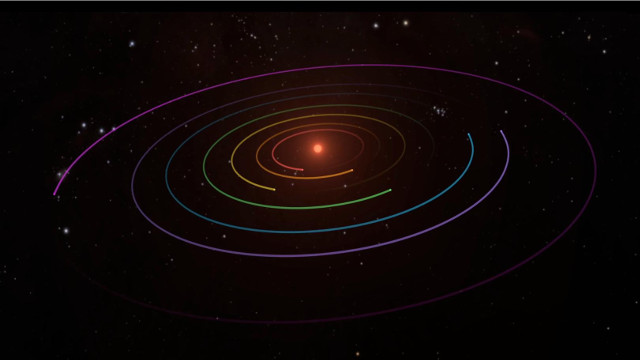
Scheme of TRAPPIST-1 planets' orbits (Image NASA/JPL-Caltech)

An article published in the journal “Nature Astronomy” reports a study on the formation of the planets of the ultra-cool star TRAPPIST-1’s system. A team of researchers exploited the particular configuration of the seven rocky planets to calculate how long their formation may have taken, obtaining a maximum value of a few million years, only a tenth of the time it took for the Earth to form. That’s because the resonance that exists between the planets can only have been maintained in the absence of a late bombardment of the kind that occurred in the solar system that completed its planets’ formation. One consequence is that water must have been absorbed by TRAPPIST-1’s planets during their formation in the protoplanetary disk.

The Prichal module docked with the International Space Station (Image NASA TV)

Yesterday, the Russian Prichal module, also known as Uzlovoy Module (UM), docked with the International Space Station’s Nauka/MLM module becoming part of the Russian section. Prichal was launched on November 24 and flown to the Station by a modified Progress cargo spacecraft. Once the task to make it fully operational is completed, it will provide five more docking hatches.

The Prichal module blasting off atop a Soyuz 2.1b rocket (Photo courtesy RSC Energia)

Yesterday, the Russian Prichal module, also known as Uzlovoy Module (UL), was launched atop a Soyuz 2.1b rocket from the Baikonur Cosmodrome, Kazakhstan. After a little more than nine minutes, it successfully separated from the rocket’s last stage and set off on its course. Its journey will take just over two days to reach the International Space Station, on November 26, where it will become part of the Russian section many years behind schedule. Prichal will be driven to its destination by a modified Progress cargo spacecraft.

The DART spacecraft blasting off atop a Falcon 9 rocket (Image NASA)

A few hours ago, NASA’s DART mission was launched on a Falcon 9 rocket from the Vandenberg base. After about 56 minutes, the spacecraft successfully separated from the rocket’s last stage and set off on its way to reaching the binary asteroid Didymos to attempt to change the orbit of its satellite Dimorphos. The impact should take place in September 2022 and be monitored from Earth and the Italian Space Agency’s LICIACube nanosatellite launched together with the space probe.

Artist concept of J0240+1952 and its companion (Image courtesy University of Warwick/Mark Garlick)

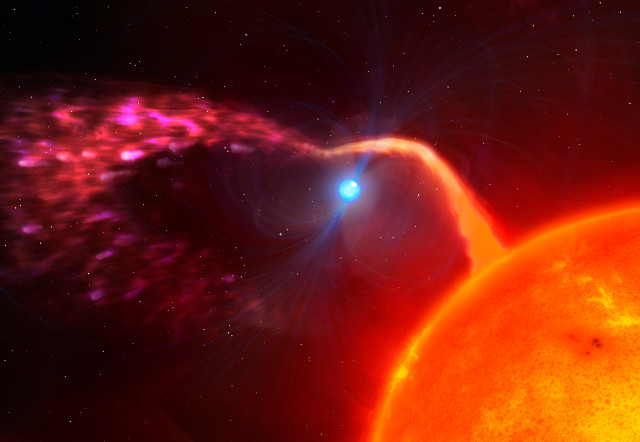
An article published in the journal “Monthly Notices of the Royal Astronomical Society: Letters” reports the discovery of the white dwarf with the fastest known rotation speed. A team of researchers used the HiPERCAM instrument mounted on the Gran Telescopio Canarias (GTC) to measure the rotation speed of the white dwarf cataloged as Lamost J024048.51+195226.9, or simply J0240+1952. Its rotation in 24.93 seconds makes it the fastest in its class. The examination also made it possible to establish that it’s a magnetic propeller system in which the white dwarf steals gas from a companion and then ejects it into space at very high speeds because of its intense magnetic field.