 Various articles published in the journals “Science”, “Journal of Geophysical Research: Planets”, and “Geophysical Research Letters” report various results of the research conducted on planet Jupiter’s atmosphere. Various teams of researchers used data gathered by NASA’s Juno space probe to obtain various results. For the first time, it’s been possible to create a 3D reconstruction of the Jovian atmosphere that offers a better understanding of how the bands that envelop the planet and are known as belts and zones work, of the polar cyclones, and the Great Red Spot.
After entering Jupiter’s orbit on July 4, 2016, the Juno space probe has been examining the planet with its instruments bringing what Lori Glaze, director of NASA’s planetary science division, called a treasure trove of information. That’s because Juno’s instruments can probe the depths of the Jovian atmosphere at levels much higher than the space probes that studied Jupiter in previous decades and the telescopes that observe the planet from a distance.
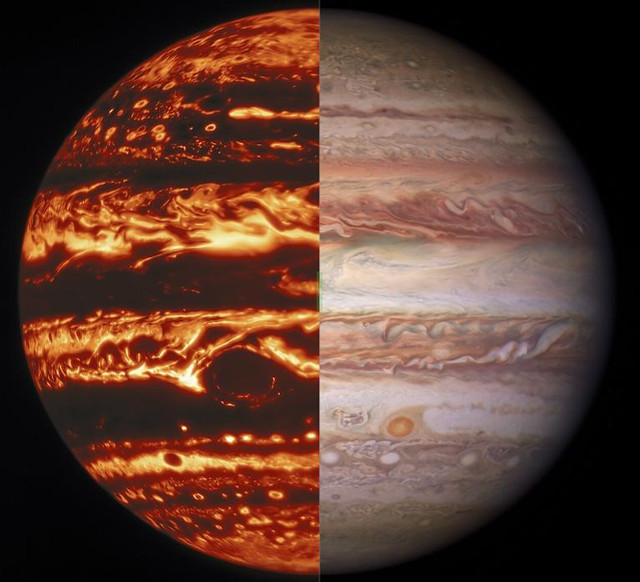
The top image (International Gemini Observatory/NOIRLab/NSF/AURA/NASA/ESA, M.H. Wong and I. de Pater (UC Berkeley) et al.) shows Jupiter with the infrared emissions detected by the Gemini Noth telescope highlighted in the left half and the visible light look in the right half as seen from the Hubble Space Telescope.
Polar cyclones were already known, with eight cyclones at the north pole and five at the south pole. The surveys carried out in particular with the Juno space probe’s JIRAM (Jovian Infrared Auroral Mapper) instrument allowed to understand how persistent they are and maintain the same position. There’s a balance between cyclones, which tend to shift towards the pole but are rejected by the central cyclone. Their slow oscillation around an equilibrium position suggests that they develop much deeper than is observed.
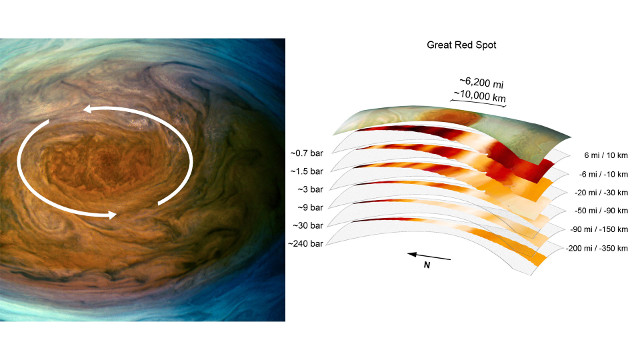
Various surveys made it possible to estimate the depth of various formations, including the iconic Great Red Spot. Some storms extend for 100 kilometers below the cloud tops but the Great Red Spot’s readings indicate that its depth is much greater. Marzia Parisi of the Juno mission team explained that the accuracy of the detections made it possible to estimate that the Great Red Spot’s depth is at least 500 kilometers under the clouds’ highest layers.
The bottom image (NASA/JPL-Caltech/SwRI/MSSS Image processing: Kevin Gill CC BY) shows the Great Red Spot. The JunoCam camera captured the photo on the left side while the MWR (Micro Wave Radiometer) instrument detected the data inside it.
The complete results represent a step forward in understanding the processes taking place on Jupiter. They will help improve models of gas giant planets in general, a field of research that is expanding also thanks to the continuous discovery of new exoplanets of that type. These are studies that intersect with those on brown dwarfs, objects halfway between planet and star.