
An article published in “The Astronomical Journal” reports the first results of an analysis of the data of the Data Release 3 (DR3) of the Lega-C astronomical survey, the largest spectroscopic survey of galaxies that we could define in their midlife since we see them as they were between about five and eight billion years ago. It offers information crucial to fully understand certain phases of the evolution of galaxies and star formation within them. Good news offered by a team of researchers led by Po-Feng Wu of the Institute of Astronomy and Astrophysics in Taipei (Taiwan) is the good consistency between the simulations of the IllustrisTNG program and of the observations conducted in that sort of census that was Lega-C.
Galaxies relatively close to the Milky Way are seen from Earth as they were a few million years ago. On the contrary, the most distant galaxies are seen from Earth as they were when they were newly formed. Between these extremes is a history spanning several billion years that is important to reconstruct to understand why the universe is as we see it today.
The VIMOS (VIsible MultiObject Spectrograph) instrument mounted on ESO’s VLT (Very Large Telescope) in Chile was used in the Lega-C astronomical survey. Between December 2014 and March 2018, it allowed observing over 3,000 galaxies we see as they were between five and eight billion years ago, in the midst of their evolution.
Preparing the data collected in such a large survey for their publication takes a long time. For this reason, the third release, the so-called Data Release 3, or simply DR3, arrived only on July 31, 2021. This release offers higher data quality, including statistical data.
One way to understand how accurate current models of galaxy evolution are is to compare the data collected by the Lega-C survey with astronomical simulations such as IllustrisTNG. It’s an extremely sophisticated simulation of the universe that has been improved over the course of years of work whose results were presented in May 2019 in an article published in the journal “Computational Astrophysics and Cosmology”.
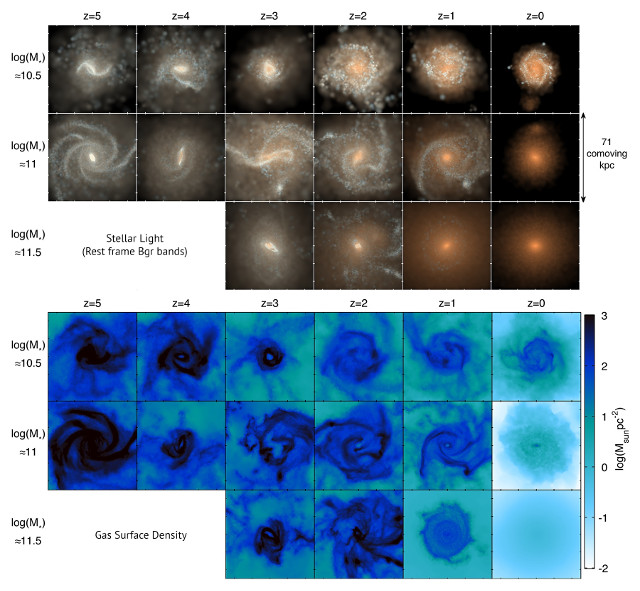
The simulation of the IllustrisTNG project coded as TNG100 was compared with the results of the Lega-C survey. The image (The Illustris Collaboration (2018)) shows the simulation of the evolution of three different galaxies from 12.5 billion years ago to the present day: in the upper panel, the visible light emissions are simulated while in the lower panel the distribution of gas inside them is represented.
The researchers found good agreement between the IllustrisTNG TNG100 simulation results and the Lega-C survey observations, however, some differences remain. There are several possible explanations and there may be more than one factor driving the discrepancies. Analyzing those discrepancies will help improve the galaxy evolution models and test even more models such as those related to dark matter and its alternatives.
