
Two articles, one published in “The Astrophysical Journal” and one (link to the file in PDF format) in “Nature Astronomy”, report as many studies on molecules detected in the early universe thanks to the ALMA radio telescope. A team led by astronomer Sreevani Jarugula of the University of Illinois, USA, detected the presence of water in the galaxy SPT0311-58, about 12.88 billion light-years from Earth, the farthest ever detected in a galaxy without an active galactic nucleus. A team led by Maximilien Franco of the University of Hertfordshire, UK, detected the presence of hydrofluoric acid in the galaxy NGP–190387, about 12 billion light-years from Earth. In this case, the discovery is also important because the mechanisms of fluorine production are not very clear, and detecting their presence when the universe was about 1.4 billion years old indicates that the so-called Wolf-Rayet stars must be an important source of this element.
In recent years, astronomers have discovered the presence of water not only in many planets and moons of the solar system but also in many other regions across the universe. In essence, we know that today it’s common in the universe, an important result also for the search for life forms similar to the Earth’s ones, but it’s not clear when it became common. The article published in “The Astrophysical Journal” indicates that, when the universe was “only” one billion years old, enough water had formed in the galaxy SPT0311-58 to be detected by the ALMA (Atacama Large Millimeter/submillimeter Array) radio telescope, inaugurated in March 2013.
The galaxy SPT0311-58 is actually a pair of galaxies wrapped in a halo of dark matter. This pair was discovered in 2017 also using the ALMA radio telescope detections possible thanks to a gravitational lens that magnified its very distant image. It’s the most massive galaxy known in the early universe, and that stimulated further studies that also led to the detection of water and carbon monoxide.
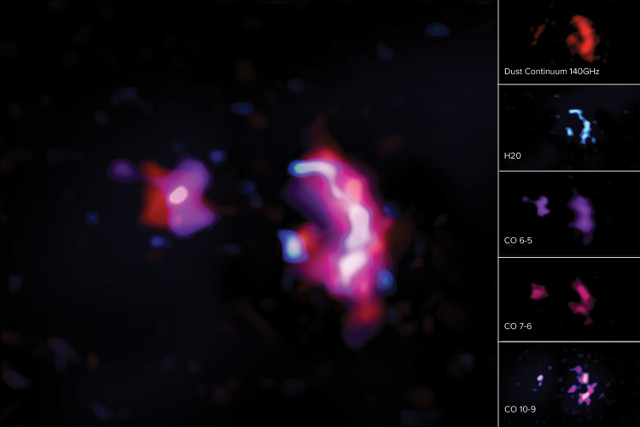
The image (ALMA (ESO/NAOJ/NRAO)/S. Dagnello (NRAO)) shows a combination of dust (red), water (blue), and carbon monoxide in three different wavelengths (purple/magenta/pink), shown individually in the panels on the right, in the galaxy SPT0311-58 as seen by the ALMA radio telescope.
The presence of oxygen and carbon to form water and carbon monoxide indicates that many stars were born and died when the universe was one billion years old. The presence of water so early in the history of the universe confirms that it’s very common and offers clues to the star formation of that era which continues to be the focus of various studies. Those early stars produced various elements that formed different molecules.
Hydrofluoric acid, or hydronium fluoride, is composed of fluorine and hydrogen but the mechanisms of fluorine production are unclear. Some elements are normally produced by stars but others require special conditions to be produced and fluorine is one of them. The article published in “Nature Astronomy” indicates that fluorine existed in the galaxy NGP–190387 about 12 billion years ago.
There are several conditions in which, at least in theory, the formation of fluorine can occur but in some cases, it takes billions of years. The detection obtained with the ALMA radio telescope in the galaxy NGP–190387 of fluorine combined with hydrogen in hydrofluoric acid shows the presence of fluorine when the universe was about 1.4 billion years old. This means that it must have been produced by a relatively quick process. According to the authors of this study, the most likely source are the so-called Wolf–Rayet stars, very massive stars that consume their hydrogen in a few million years.
The galaxy NGP–190387 is another one that can be studied thanks to a gravitational lens that magnifies its image. The surprising discovery of the presence of fluorine offers further information on the activity of primordial galaxies and the formation of elements within them. The Extremely Large Telescope (ELT) under construction in Chile will allow more studies with the detection of the light from the stars of the galaxy NGP–190387 and other primordial galaxies to better understand that phase of the history of the universe.
