An article accepted for publication in the journal “Astronomy & Astrophysics” offers an overview of the results of the MGCLS (MeerKAT Galaxy Cluster Legacy Survey) project, which covers 115 galaxy clusters. A team of researchers led by Kenda Knowles of the University of KwaZulu-Natal, South Africa, used the MeerKAT radio telescope for a total of approximately 1,000 hours of observations to obtain images that were processed and analyzed. These are only the first results of an investigation that can bring new information on the processes taking place in those 115 clusters.
Galaxy clusters are the largest structures in the universe. For this reason, studying them means improving our knowledge of a wide range of cosmic processes. Observations in different bands of the electromagnetic spectrum offer different information, which also depends on the intensity of the emissions of the objects studied and on the power and sensitivity of the instrument used.
The MeerKAT radio telescope is one of the precursors of the SKA, the next-generation radio telescope, and is already delivering extraordinary results thanks to the technologies being developed for the SKA. The MGCLS survey is based on 1,000 hours of observations conducted in 2019, the year after the activation of MeerKAT, and allowed to test its performance on large and medium angular scales of radio emissions from galaxy clusters.
The selected galaxy clusters have already been studied, both in radio waves and in other electromagnetic bands, and were observed with the MeerKAT radio telescope to verify the possibility of discovering new radio sources. The result was positive thanks to the success in that type of discovery with dozens of new sources discovered and presented in the article.
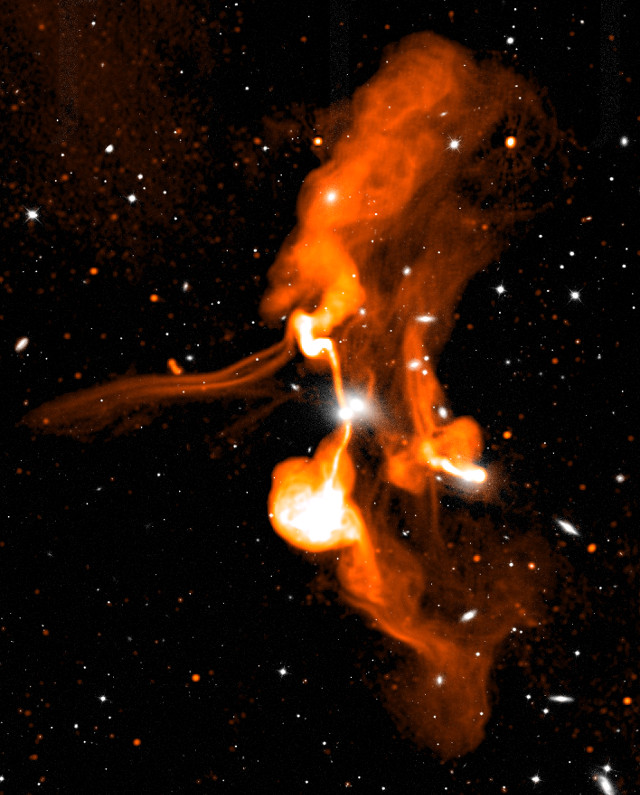
The top image (Adapted from K. Knowles et al., “The MeerKAT Galaxy Cluster Legacy Survey. I. Survey Overview and Highlights” (Astronomy & Astrophysics, in press). Image credits: SARAO) shows the radio tracks of a powerful merger in progress between two or more massive groups of gas and galaxies in the cluster MCXC J0352.4-7401 for an extension of about 10 million light-years.
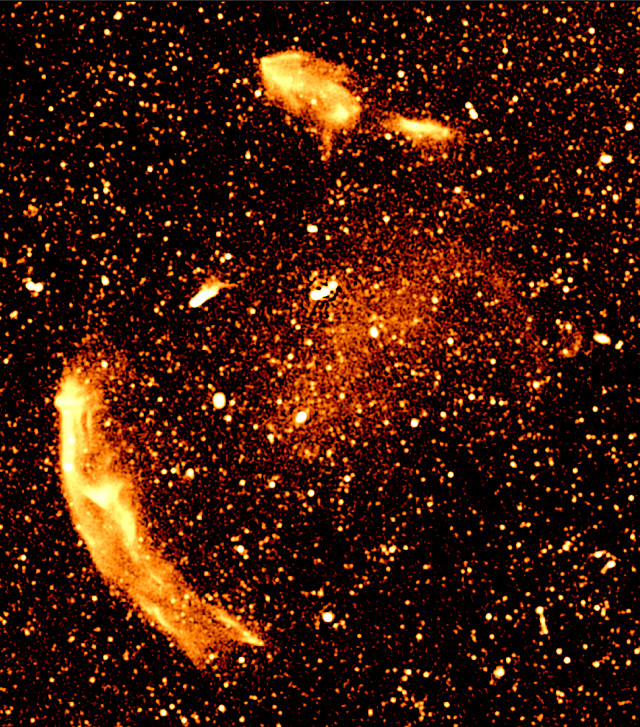
The bottom image (Adapted from K. Knowles et al., “The MeerKAT Galaxy Cluster Legacy Survey. I. Survey Overview and Highlights” (Astronomy & Astrophysics, in press). Image credits: SARAO, SDSS) shows two giant radio galaxies with an extension of more than one million light-years at the center of a large group of galaxies in the Abell 194 cluster. The radio emissions reveal the presence of relatively narrow magnetic filaments in the region and complex interactions between the radio emissions of the two galaxies.
This result, which is only the first of the MGCLS survey, is the product of two years of work in converting observation data with powerful computers and subsequent analysis. The sources discovered have only in part an explanation and follow-up studies will be conducted to understand the origin of the mysterious ones. In the meantime, some studies have already begun that go in-depth into some of the initial discoveries. The publication of the data will allow astronomers outside the MGCLS team to join the research and use the data alongside other observations, as is normal for the results of this type of survey. It’s called DR1 (Data Release 1) because it’s the first publication but further processing and analysis may lead to other publications over the years.
The results of the MGCLS survey are one of the confirmations of the exceptional performance of the MeerKAT radio telescope. Its current 64 antennas will be extended to 80 in the phase of the project called MeerKAT+, the one that will be integrated into the SKA radio telescope in a few years. These steps forward will allow looking ever deeper into the structures of the universe to discover more of their secrets.