
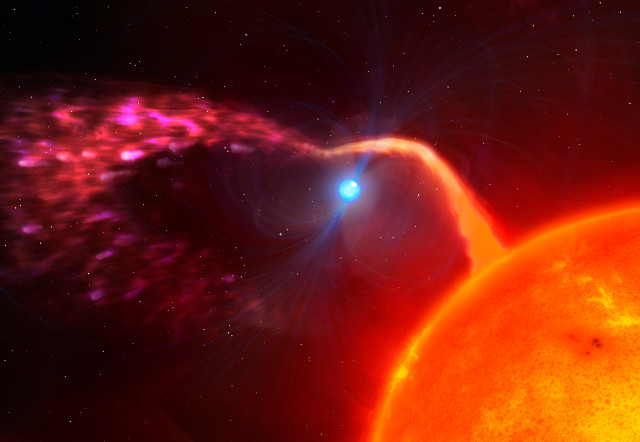
An article published in the journal “Monthly Notices of the Royal Astronomical Society: Letters” reports the discovery of the white dwarf with the fastest known rotation speed. A team of researchers used the HiPERCAM instrument mounted on the Gran Telescopio Canarias (GTC) to measure the rotation speed of the white dwarf cataloged as Lamost J024048.51+195226.9, or simply J0240+1952. Its rotation in 24.93 seconds makes it the fastest in its class. The examination also made it possible to establish that it’s a magnetic propeller system in which the white dwarf steals gas from a companion and then ejects it into space at very high speeds because of its intense magnetic field.
White dwarfs are the remnants of a star with a mass similar to that of the Sun at the end of its normal life. In J0240+1952’s case, its size is close to the Earth’s because the core of the progenitor star compacted to that size even though its mass is about 200,000 times the Earth’s.
The white dwarf J0240+1952 has changed over time due to interactions with its companion. When it started stealing gas from its companion, that gas fell upon it at very high speeds, providing the energy that progressively increased its rotation speed.
At some point in its evolution, the white dwarf J0240+1952 developed a strong magnetic field, which started acting as a barrier. For this reason, part of the gas it steals from its companion started getting ejected into space in what the researchers believe is an example of a system called a magnetic propeller system.
The growth of the magnetic field has increased the amount of gas ejected over time. What remains is guided to the magnetic poles of J0240+1952, where it concentrates in bright spots on its surface. That brightness generates what, due to the white dwarf’s spin, appears as pulsations, and that made it possible to measure its rotation speed.
The ejected materials were first observed in 2020 but few instruments can offer observations of the pulsations of the quality needed to measure their velocity. For this reason, it was necessary to use the HiPERCAM, a very sensitive instrument mounted on the GTC and activated in February 2018. The time of 24.93 seconds per rotation measured breaks the previous record, which was held by WZ Sagittae with about 29 seconds for a rotation.
Ingrid Pelisoli of the British University of Warwick, lead author of the article, explained that the rotation of the white dwarf J0240+1952 is so fast that, to remain intact, it must have a mass above the average of that type of object.
The white dwarf J0240+1952 also represents an important discovery as a magnetic propeller system. In fact, so far, AE Aquarii’s system was the only one of its kind discovered in over 70 years since the announcement of its discovery was published in 1949.
The white dwarf J0240+1952 looks truly extraordinary, and for this reason, will continue to be studied. The researchers intend to use it to verify the model for the magnetic propeller system developed for AE Aquarii. Another part of its study will consist of monitoring its rotation speed because they expect it to slow down quickly over time.
