November 2021

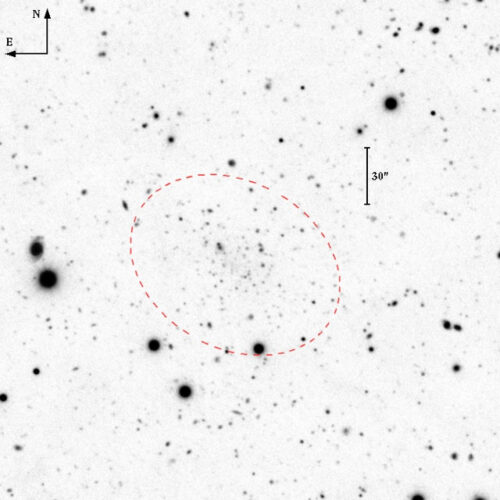
The dwarf galaxy Pisces VII seen by DOLoRes (Image courtesy W. Boschin/TNG)

An article published in the journal “Monthly Notices of the Royal Astronomical” reports the confirmation of the discovery of the dwarf galaxy Pisces VII, which could be a satellite of the Triangulum galaxy. A team of researchers led by David Martínez-Delgado of the Instituto de Astrofisica de Andalucia used the DOLoRes instrument at the Galileo National Telescope to confirm the existence of Pisces VII, originally identified by the amateur astronomer Giuseppe Donatiello. The gravitational bond with the Triangulum galaxy has yet to be verified but if the outcome were positive it would be a confirmation of the theories concerning galaxy formation, which predict the presence of various satellite galaxies. The reference is to the Lambda-CDM model, which also concerns dark matter.

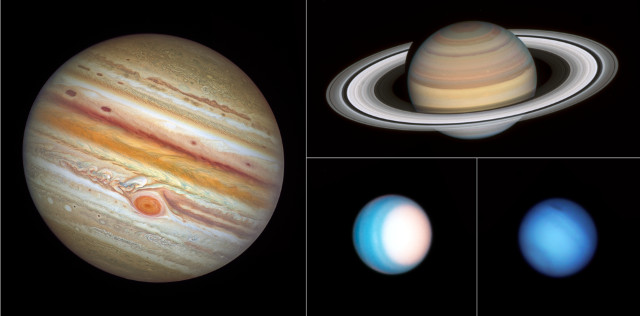
Jupiter, Saturn, Uranus, and Neptune seen by Hubble

A composition of images captured by the Hubble Space Telescope brings together the solar system’s giant planets on a grand tour of the outer planets. Jupiter, Saturn, Uranus, and Neptune are among the targets of periodic observations in programs such as OPAL (Outer Planets Atmospheres Legacy) to keep an eye on the changes that occur over time in their atmospheres. Along with other instruments, which in some cases include space probes, Hubble is an important contributor to studies of gas planets. Programs such as OPAL are also useful in developing models for studying gas exoplanets in other star systems.

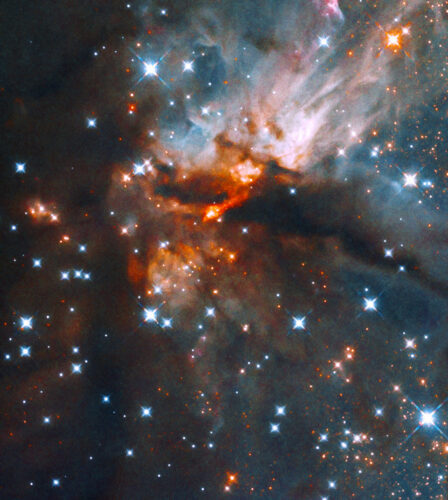
The G035.20-0.74 nebula (Image NASA, ESA, and J. Tan (Chalmers University of Technology); Processing; Gladys Kober (NASA/Catholic University of America))

NASA has released an image captured by the Hubble Space Telescope of the nebula cataloged as G035.20-0.74, a star nursery in the constellation Aquila. In this specific case, the stars that are born are really massive, B-Type blue giants that are up to five times hotter than the Sun. Their formation is among the astronomers’ research objects and within G035.20- 0.74 there’s a massive protostar that is emitting jets of gas. It’s a phenomenon known in protostars but it’s difficult to observe in the ones so massive, which tend to be surrounded by larger quantities of dust that hide them.

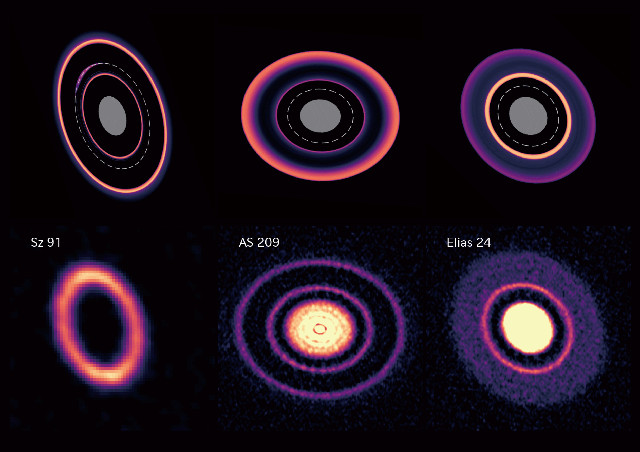
Simulations of protoplanetary disks indicate the movements of newborn planets

An article published in “The Astrophysical Journal” reports a study on protoplanetary disks that offers a solution to the rarity of the discovery of newborn exoplanets near the rings that form inside them. A team of three Japanese researchers used the ATERUI II supercomputer, the most powerful used in astronomy, to create simulations of planetary systems’ evolution. The results indicate that the planets create rings as they grow but subsequently move away from them.

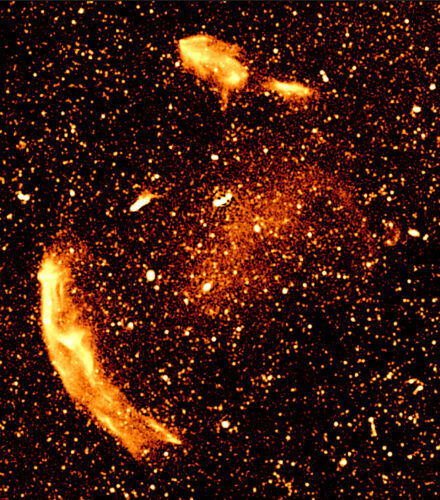
The radio tracks of a powerful merger in progress between two or more massive groups of gas and galaxies in the cluster MCXC J0352.4-7401

An article accepted for publication in the journal “Astronomy & Astrophysics” offers an overview of the results of the MGCLS (MeerKAT Galaxy Cluster Legacy Survey) project, which covers 115 galaxy clusters. A team of researchers led by Kenda Knowles of the University of KwaZulu-Natal, South Africa, used the MeerKAT radio telescope for a total of approximately 1,000 hours of observations to obtain images that were processed and analyzed. These are only the first results of an investigation that can bring new information on the processes taking place in those 115 clusters.