November 2021

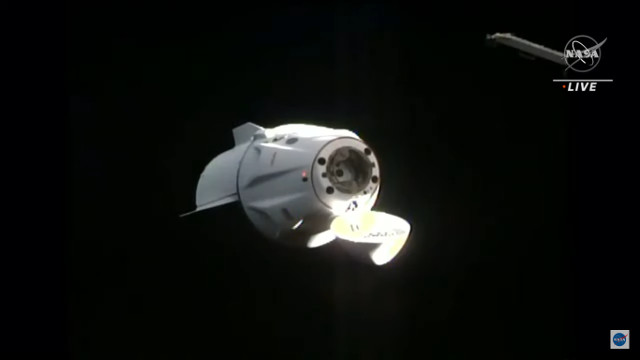
The Crew Dragon Endurance spacecraft approaching the International Space Station (Image NASA TV)

A few hours ago, SpaceX’s Crew Dragon Endurance spacecraft docked to the International Space Station’s Harmony module completing the first part of its Crew-3 or SpaceX Crew-3 mission that began yesterday with its launch. After checking that the pressure is correctly balanced, the hatch will be opened to allow Raja Chari, Thomas Mashburn, Matthias Maurer, and Kayla Barron to enter the Station. The Endurance reached the Station about 40 minutes earlier than the original schedule.

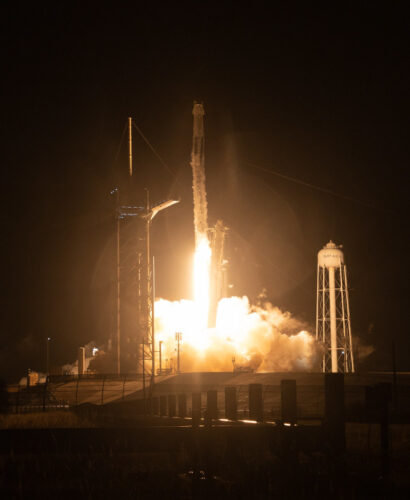
The Crew Dragon Endurance spacecraft blasting off atop a Falcon 9 rocket (Photo NASA/Joel Kowsky)

A few hours ago, SpaceX’s Crew Dragon Endurance spacecraft blasted off atop a Falcon 9 rocket from the Kennedy Space Center in its Crew-3 or SpaceX Crew-3 mission. After about eleven minutes, it successfully separated from the rocket’s last stage and went en route to carry out its mission. This is the third crewed mission of the Crew Dragon spacecraft within the normal rotation of the International Space Station crew. This is also the first mission for the Endurance and is the first to transport rookie astronauts.

The Crew Dragon Endeavour spacecraft departin hte International Space Station (Photo NASA)

A few hours ago, SpaceX’s Crew Dragon Endeavour spacecraft ended its Crew-2, or SpaceX Crew-2, mission on behalf of NASA by splashing down without problems. Onboard were astronauts Thomas Pesquet, Megan McArthur, Shane Kimbrough, and Akihiko Hoshide, who reached the International Space Station on April 24, were part of the Expeditions 65 and 66. They finished SpaceX’s second regular crewed mission in the Atlantic Ocean off the coast of Pensacola, Florida. The Crew Dragon left the International Space Station about 8.5 hours earlier. Shortly after splashing down, the SpaceX ship called “Go Navigator” went to retrieve the Crew Dragon and its crew to transport them to the coast.

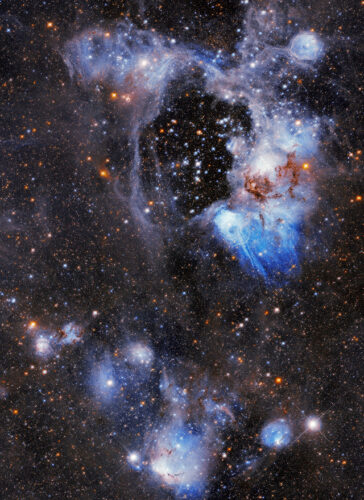
The N44 nebula (Image NASA, ESA, V. Ksoll and D. Gouliermis (Universität Heidelberg), et al.; Processing: Gladys Kober (NASA/Catholic University of America))

NASA has released an image captured by the Hubble Space Telescope of N44, an emission nebula in the Large Magellanic Cloud. Its classification is due to the fact that it glows because of electromagnetic emissions generated by the ionization caused by the stars present in that area. A really curious formation inside it is what was called a superbubble, a kind of cavity inside N44 that’s still without a certain explanation. The stellar winds in the nebula don’t seem to have the necessary characteristics, so the most widely considered hypothesis is that the cavity was excavated by supernovae.

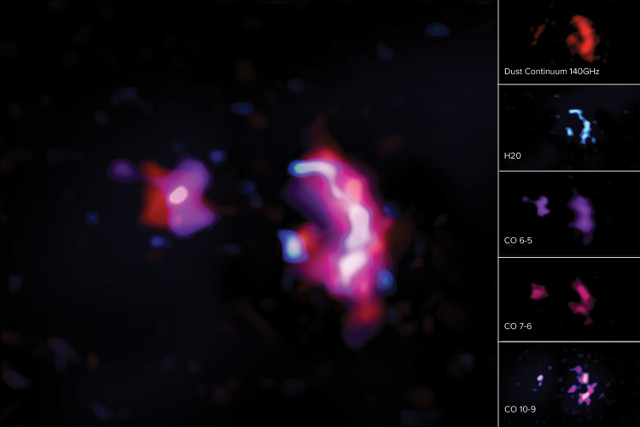
Water and carbon monoxide in the galaxy SPT0311-58 as seen by the ALMA radio telescope

Two articles, one published in “The Astrophysical Journal” and one in “Nature Astronomy”, report as many studies on molecules detected in the early universe thanks to the ALMA radio telescope. A team led by astronomer Sreevani Jarugula of the University of Illinois, USA, detected the presence of water in the galaxy SPT0311-58, about 12.88 billion light-years from Earth, the farthest ever detected in a galaxy without an active galactic nucleus. A team led by Maximilien Franco of the University of Hertfordshire, UK, detected the presence of hydrofluoric acid in the galaxy NGP–190387, about 12 billion light-years from Earth. In this case, the discovery is also important because the mechanisms of fluorine production are not very clear, and detecting their presence when the universe was about 1.4 billion years old indicates that the so-called Wolf-Rayet stars must be an important source of this element.