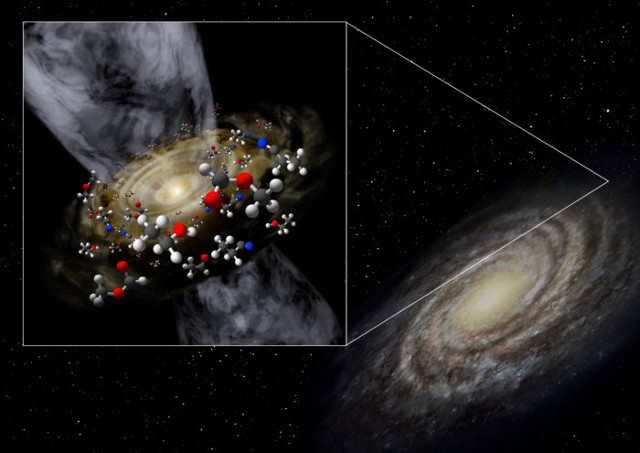
An article published in “The Astrophysical Journal” reports the discovery of complex organic molecules around a protostar at the edge of the Milky Way. A team of researchers led by astronomer Takashi Shimonishi of the Niigata University, Japan, used the ALMA radio telescope to examine the area around a protostar in the region cataloged as WB89-789 detecting the presence of molecules such as methanol, ethanol, methyl formate, dimethyl ether, formamide, propanenitrile, and others. This is the first time that complex organic molecules, the kind that can form prebiotic molecules, have been discovered at the edge of the Milky Way, and this suggests that they can form with an efficiency similar to that existing within the galaxy, in the Sun’s “neighborhood”.
The search for complex organic molecules is important to try to understand where and how the conditions for the birth of life forms can exist. The spectroscopic analysis of electromagnetic emissions coming not only from stars but also from gas and dust clouds allows detecting the traces that simple elements and more or less complex molecules leave in them. This type of analysis allowed to establish that simple organic molecules are common while other, more complex, ones are more difficult to detect near some stars.
One of the questions about the formation of complex organic molecules concerns the areas of the Milky Way where it can occur. The environment in the galaxy’s outermost area is believed to be primitive, of the kind that was common during galactic formation. In that area, there’s a poor presence of heavy elements and the perturbations caused by the arms of the galactic spiral are little or non-existent. Those are among the characteristics that make that area very different from the rest of the Milky Way, including the Sun’s neighborhood, and astronomers are interested in studying star formation in that environment.
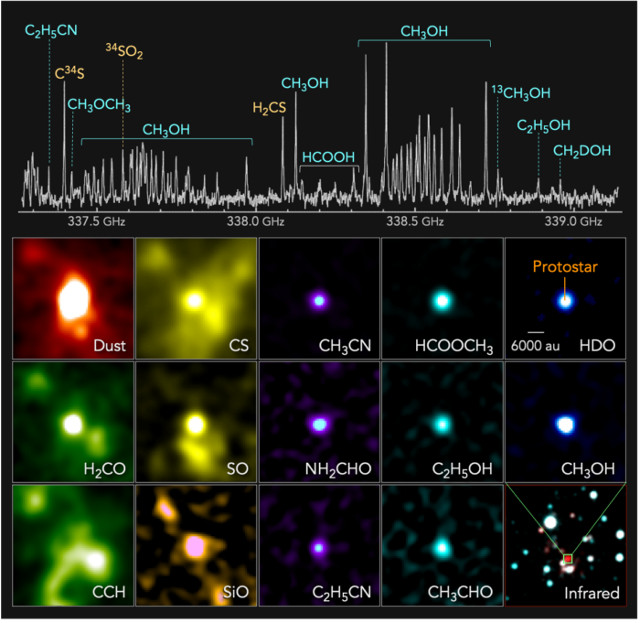
The power and sensitivity of the ALMA (Atacama Large Millimeter / submillimeter Array) radio telescope, inaugurated in March 2013, made it possible to conduct detections in a star-forming region in the Milky Way’s outermost area cataloged as WB89-789. Around a protostar, ALMA detected the presence of complex organic molecules such as methanol, ethanol, methyl formate, dimethyl ether, formamide, propanenitrile. The top image (ALMA (ESO/NAOJ/NRAO), T. Shimonishi (Niigata University)) shows the traces of various molecules in the protostar’s emissions along with an infrared view.
Organic molecules of such complexity can form even more complex prebiotic molecules. The fact that this can happen in the conditions existing at the borders of the Milky Way is very interesting in astrobiology studies and in particular in studies on the conditions that can lead to the birth of life forms.
The object of this study is a protostar that can offer limited answers, even on the star-forming region WB89-789. Further studies will be needed to understand whether the formation of complex organic molecules is common in the outer area of the Milky Way or the protostar studied is a lucky discovery. Takashi Shimonishi’s team intends to look at a larger number of star-forming regions to understand if in the conditions that were common when the universe was much younger there was already a good chance for life forms to emerge.