
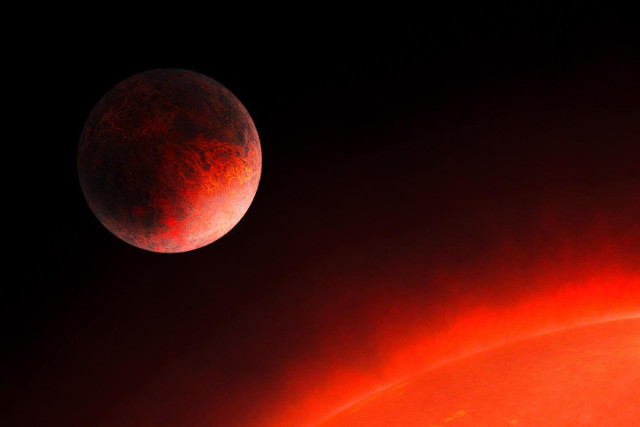
An article published in the journal “Science” reports the discovery of the exoplanet GJ 367 b, about the size of Mars, with a year lasting only eight hours. A team of researchers led by Kristine Lam and Szilárd Csizmadia of DLR, the German aerospace agency, used observations conducted by NASA’s TESS space telescope and follow-up detections conducted with the ESO’s 3.6-meter telescope in La Silla, Chile’s HARPS instrument to obtain information on GJ 367 b. You could say that it’s a super-Mercury since the two planets have a similar iron core but on the side of GJ 367 b facing its star, a red dwarf, the estimated temperature is about 1,500° Celsius.
About 31 light-years away from Earth, the star GJ 367 has a mass that is nearly half the Sun’s and is much less hot than the Sun. NASA’s TESS Space Telescope, launched on April 18, 2018, detected traces of a rocky planet around GJ 367 over the course of a month between February 28 and March 26, 2019. It was cataloged as GJ 367 b and is very close to its star. This type of planet is called an ultra-short period for the extremely short duration of its year, in this case almost eight hours to orbit its star.
GJ 367’s system is astronomically nearby, so it was possible to conduct follow-up, high-precision observations with the HARPS (High Accuracy Radial Velocity Planet Searcher) instrument installed on ESO’s 3.6-meter telescope in La Silla, in Chile. This allowed obtaining more detections and more precise information on the exoplanet GJ 367 b.
The result of the examination of the exoplanet GJ 367 b is that it’s a rocky planet with a radius that is 72% of the Earth’s and a mass that is 55% of the Earth’s. It’s similar in size to Mars, which makes it one of the smallest known planets so far. However, its density indicates that it has an iron-rich core that is estimated to make up about 86% of the interior of GJ 367 b. These are characteristics that make it similar to Mercury with temperatures on its surface much higher than those of the solar system’s innermost planet. GJ 367 b is tidally locked and always shows its star the same face where the temperature can reach values estimated at 1,500° Celsius.
Other exoplanets with a year shorter than an Earth day have been discovered over the years. Astronomers think they formed in an area farther from their star, especially the so-called hot Jupiters, too massive to form in an area where the star is supposed to have absorbed all or most of the gas. Planetary migration is an object of study that expanded over the years thanks to the discovery of new exoplanets. Again, the relative proximity of GJ 367’s system can help the research.
In order to obtain complete studies on the exoplanet GJ 367 b, it’s necessary to understand if there are other planets orbiting its star. That’s because gravitational interactions between planets are crucial in planetary migration. The problem is that planets farther from their star are less likely to pass between it and a telescope, so they’re more difficult to detect. Now that the system is known, it will continue to be studied to get to know it better.
