
An article accepted for publication in “The Astrophysical Journal” reports a study on the pulsar cataloged as 1RXS J141256.0+792204 and nicknamed Calvera, a reference to the movie “The Magnificent Seven” due to the fact that it’s an isolated pulsar like the previously known ones, nicknamed the magnificent seven. A team of researchers from the Italian National Institute of Astrophysics and the University of Padua used the NICER instrument on the International Space Station to study Calvera. The conclusions are that this pulsar is in the Milky Way’s halo, much farther than estimated after its discovery, and is much younger than the magnificent seven.
Pulsars are a type of neutron star, one of the possible remnants of stars more massive than the Sun after their death. Generally, they’re associated with remnants of the supernova that marks the death of the progenitor star, often with a companion, and radio pulses. In the 1990s, astronomers discovered seven isolated neutron stars which were nicknamed the magnificent seven. They have been observed only in thermal X-rays they emit due to their cooling, and are so energetic because they have a surface temperature of around a million degrees.
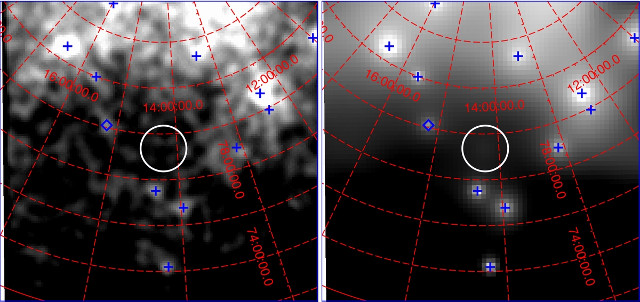
Discovered in 2007, Calvera is the eighth isolated neutron star and its nickname is a playful reference to a character from the movie “The Magnificent Seven”. Over the years, it has been studied several times with various difficulties precisely because it’s isolated. The image (Courtesy Halpern et. al. All rights reserved) shows the area around Calvera (in the circle) observed by the Fermi space telescope’s LAT instrument. This new study offers estimates of its characteristics that are very different from the first ones.
This new study was conducted using the NICER (Neutron Star Interior Composition Explorer) instrument, a telescope installed on the International Space Station precisely to study neutron stars. It made it possible to obtain information that led the researchers to very different conclusions from those of previous years.
Calvera was initially referred to as a neutron star close to Earth in astronomical terms, perhaps the closest with an estimated distance between 250 and 1,000 light-years from Earth. Instead, The new observations indicate that it’s far away, in the Milky Way’s halo, at a distance of at least 10,000 light-years from Earth.
Another conclusion regarding Calvera concerns its age. The magnificent seven isolated pulsars are estimated to be around one million years old while this new study suggests that Calvera is much younger with an age now estimated at around three hundred thousand years.
According to the researchers, Calvera was born in the galactic halo but it’s difficult to have reasonable certainty about its progenitor star. In that area, there are mainly small stars that don’t explode in supernovae, so it’s possible that Calvera’s progenitor came from the galactic disk, a so-called runaway star with a very high speed generated by gravitational interactions. The alternative possibility is that Calvera is the result of a collapse of a white dwarf born from the death of a Sun-like star that had a companion from which it stole enough gas to turn into a neutron star. This would be the first known case of this type.
Probably, Calvera is a normal neutron star born well above the galactic disk but the fact that it’s isolated constitutes an anomaly and makes its study more difficult. Consequently, we can expect more surprises from the studies of this neutron star. Instruments such as NICER can provide an important aid in the observation of extreme objects such as Calvera to better understand their origin and evolution.
