
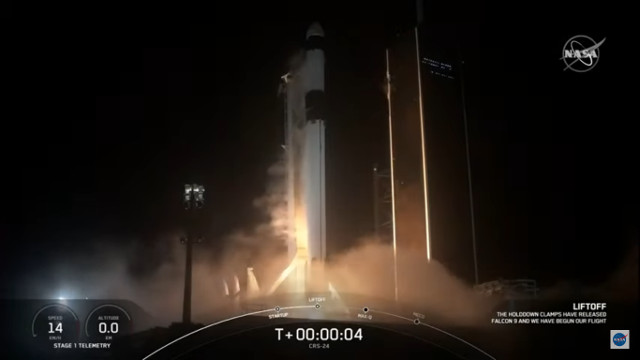
A little while ago, the SpaceX Dragon 2 spacecraft blasted off atop a Falcon 9 rocket from the Kennedy Space Center in its CRS-24 (Cargo Resupply Service 24) mission, also referred to as SPX-23. After almost exactly 12 minutes it separated successfully from the rocket’s last stage and went en route. This is the 24th mission, the 4th for the Dragon 2 version, for the Dragon spacecraft to resupply the International Space Station with various cargoes and then return to Earth, again with various cargoes.
The Dragon 2 spacecraft’s cargo is almost 3,000 kg (almost 6,600 lbs) between the pressurized and the non-pressurized section. There are about 850 kg (almost 2,500 lbs) of food and other supplies for the International Space Station crew but most of the cargo consists of instruments, hardware, and various other materials needed for science experiments and research conducted aboard the Station.
The Bioprint FirstAid experiment of the German aerospace agency DLR uses a kind of portable biological printer to create a kind of biological patch from the patient’s skin cells. The result is used as a patch in case of wounds to speed up the healing process. It’s a type of personalized treatment useful in space missions that can be developed for applications on Earth.
CASIS PCG 20 is an experiment involving monoclonal antibodies. It’s a type of treatment that has come to fame in the fight against Covid-19 but actually, it concerns a number of diseases including various forms of cancer. Microgravity crystallization testing of a type of monoclonal antibody developed by Merck Research Labs may help improve this type of care by facilitating its administration.
(MVP) Plant-01 is one of the experiments involving the growth of plants in microgravity, in this case, focused on monitoring the development of shoots and roots. The results will help develop plants that can grow in space habitats, on the Moon, or Mars.
Turbine Superalloy Casting Module (SCM) will test commercial equipment to produce heat-resistant alloys in microgravity. The point is to verify the differences in the results with respect to the conditions of Earth’s gravity and to assess the improvements given by a more homogeneous structure of the alloy that should derive from the microgravity.
This Dragon 2 cargo spacecraft is the same one used in the CRS-22 mission. The first stage is new and, 6 years after the first success in a controlled landing, utilizing a first stage that is not used is what makes the news. The landing of this first stage on the “Just Read Instructions” drone ship is the 100th landing for a SpaceX Falcon 9 first stage. The Dragon 2 cargo station is scheduled to arrive at the Station on Wednesday: around 9.30 UTC, it should dock with the Station with an automated maneuver.
