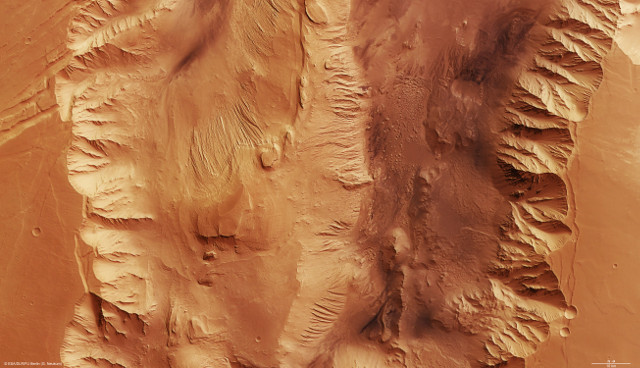
An article published in the journal “Icarus” reports the identification of traces of water in the subsoil of the Valles Marineris, the largest system of canyons on the planet Mars. A team of researchers used data collected by FREND instrument of TGO space probe, part of ESA and Roscosmos’ ExoMars program, to map hydrogen, generally bound to oxygen into water molecules, in the soil’s upper layer. The area marked by the presence of water has a size close to those of the Netherlands, and part of it is located in the valleys of Candor Chasma, in the northern part of the Valles Marineris. That marks the discovery of water in the equatorial regions of Mars, where it was believed that temperatures were not low enough to prevent the sublimation of water so close to the surface.
The Martian polar ice caps contain various frozen compounds, including water. In those areas, temperatures are low enough to keep water stable despite the very low atmospheric pressure. However, temperatures at the Martian equator are higher and the water near the surface should sublimate or so it seemed until the TGO (Trace Gas Orbiter) space probe, which entered the red planet’s orbit on October 19, 2016, detected it in the Valles Marineris.
In particular, the FREND (Fine Resolution Epithermal Neutron Detector) instrument is a special telescope capable of mapping the presence of hydrogen in the Martian ground’s upper meter. This element is generally bound to oxygen, so its mapping is practically equivalent to that of the presence of water.
Analyzes of the data collected by FREND between May 2018 and February 2021 made it possible to find a significant amount of water in the Valles Marineris, the gigantic system of canyons that stretches for about 3,000 kilometers near Mars’ equator. The water reaches Candor Chasma, a system of tectonic features of the type called graben in jargon in the northern part of the Valles Marineris.
Such analyzes had already been done in the past but were based on instruments with a much lower spatial resolution than FREND which allowed to detect only the water in the polar caps. For this reason, only now it’s been possible to discover water in the Valles Marineris even though it’s present in an area as large as the Netherlands. Igor Mitrofanov of the Space Research Institute of the Russian Academy of Sciences in Moscow, Russiam, lead author of the article, explained that the TGO space probe allows to look up to one meter below the dusty surface to see what is really going on.
The common dust on the Martian surface is exactly what could cover the water, which is probably present in the form of ice. Another possibility is that it’s liquid when chemically bound to other minerals in the soil but is less likely. Other research showed the possibility that liquid water exists when mixed with compounds that act as antifreeze but there are discussions that have been going on for some time about the interpretation of the data.
The doubts and subsequent discussions on these findings show the difficulty in understanding precisely what is detected by space probes in orbit. Also in the case of the water in the Valles Marineris, other observations and analyzes of the data collected will be necessary to understand the state of the discovered water. They will also be useful studies for possible future explorations to be carried out in new missions on Mars.