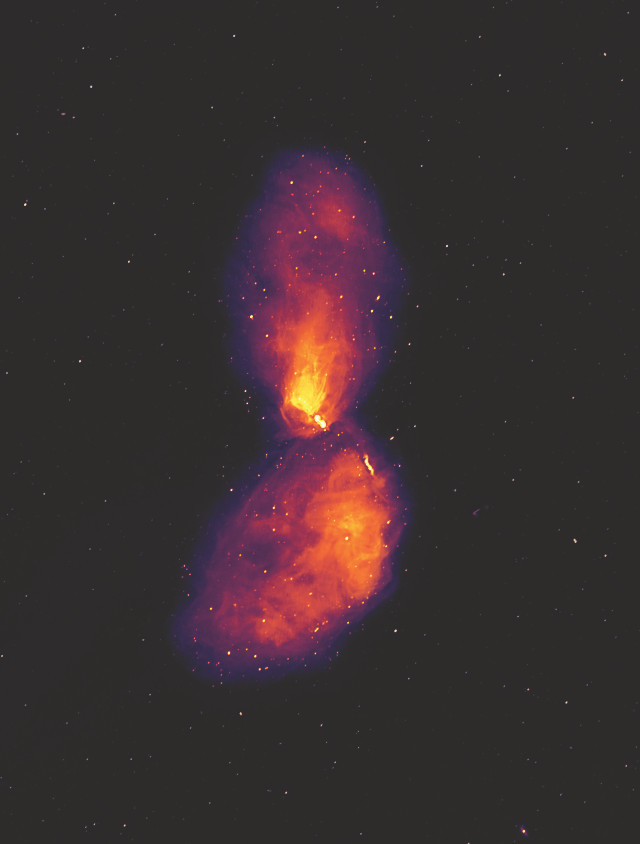
An article published in the journal “Nature Astronomy” reports the observation of a cosmic eruption in the galaxy Centaurus A which, despite being about 12 million light-years away, has an extension in the Earth’s sky equivalent to that of 16 full Moons side by side. A team of researchers used the MWA radio telescope to detect the radio emissions generated by the supermassive black hole at the center of Centaurus A. The observations show a gigantic bipolar outflow with unprecedented quality. This allowed confirming a new interdisciplinary theory known as CCA (Chaotic Cold Accretion) regarding the interaction between the gas halos possessed by galaxies and the supermassive black holes they host.
The activity of supermassive black holes is an important subject of astronomical studies of various kinds. However, that study can be difficult when it happens billions of light-years away. An active object of that type is at the center of Centaurus A, an elliptical galaxy about 12 million light-years away, therefore relatively close, making it the closest among radio galaxies, sources of powerful radio emissions thanks to their active galactic nuclei powered by supermassive black holes at their center.
Dr. Benjamin McKinley from the Curtin University node of ICRAR (International Center for Radio Astronomy Research), lead author of this study, explained that radio waves come from materials that are sucked into the supermassive black hole. When these materials are swallowed, powerful jets eject most of them into space, at distances likely to exceed a million light-years.
Centaurus A was already the subject of radio observations but the problem was the opposite of normal, in the sense that in this case, the jets were too bright for the instruments used. The result was a distortion of the details of the area surrounding this galaxy. The MWA (Murchison Widefield Array) radio telescope in Australia has overcome this problem.
The bipolar outflow of materials ejected from the supermassive black hole of the galaxy Centaurus A has an estimated speed of about 1,100 kilometers per second with the ejection of a mass estimated to be around 2.9 solar masses every year. Despite the distance, this cosmic eruption has an extension equal to eight degrees, the equivalent of 16 full Moons side by side.
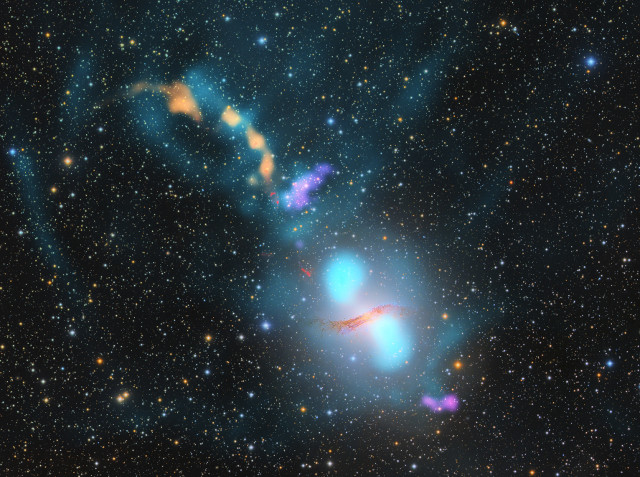
Other data on the Centaurus A galaxy detected in other bands of the electromagnetic spectrum complemented the data collected with the WMA radio telescope. The bottom image (Connor Matherne, Louisiana State University (Optical/Halpha), Kraft et al. (X-ray), Struve et al. (HI), Ben McKinley, ICRAR/Curtin. (Radio)) shows a composition with hot X-rays shown in orange, cold neutral hydrogen in purple, and clouds emitting in the so-called H-alpha emission line in red on an image captured at optical frequencies.
This study offers confirmation of the CCA (Chaotic Cold Accretion) theory. In this model, galaxy halos behave similarly to the Earth’s atmosphere. Each galaxy has a halo of gas spread over tens of thousands of light-years from which clouds of cold gas condense cyclically. These clouds partly form the galactic atmosphere and partly generate a sort of rain on the central regions, feeding the supermassive black hole. This process creates an active galactic nucleus and the powerful radio emissions observed in this study.
The MWA radio telescope is one of the precursors of the SKA, the next-generation radio telescope currently under development. When it goes into operation, it will be possible to obtain even higher quality observations of many cosmic phenomena that will help to better understand various processes, including those connected to the “galactic weather”.