December 2021

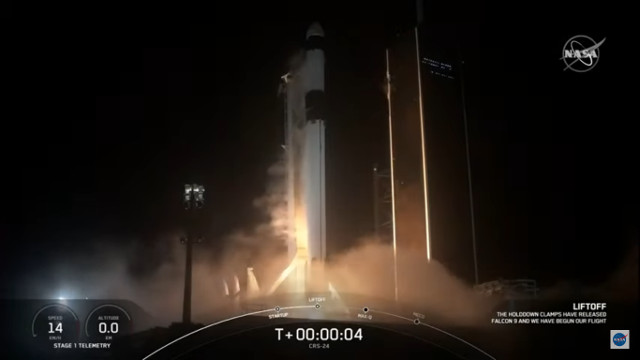
SpaceX's Dragon 2 spacecraft blasting off atop a Falcon 9 rocket (Image NASA TV)

A little while ago, the SpaceX Dragon 2 spacecraft blasted off atop a Falcon 9 rocket from the Kennedy Space Center in its CRS-24 (Cargo Resupply Service 24) mission, also referred to as SPX-23. After almost exactly 12 minutes it separated successfully from the rocket’s last stage and went en route. This is the 24th mission, the 4th for the Dragon 2 version, for the Dragon spacecraft to resupply the International Space Station with various cargoes and then return to Earth, again with various cargoes.


Yusaku Maezawa, Alexander Misurkin, and Yozo Hirano on the International Space Station (Image NASA TV)

A few hours ago, cosmonaut Alexander Misurkin, Japanese billionaire Yusaku Maezawa, and Yozo Hirano returned to Earth on the Soyuz MS-20 spacecraft, which landed in Kazakhstan, after spending 12 days on the International Space Station, where they arrived on December 8. It was a space tourism journey set up in an agreement between the private company Space Adventures and the Russian space agency Roscosmos.

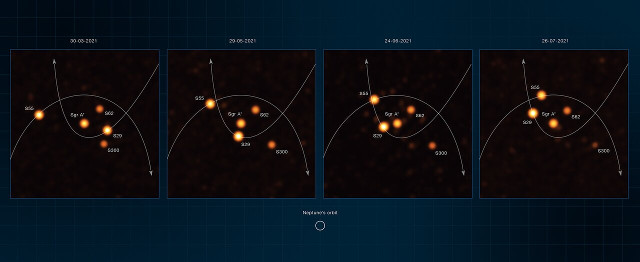
Some of the stars orbiting Sagittarius A*

Two articles published in the journal “Astronomy & Astrophysics” report aspects of a research on Sagittarius A*, the supermassive black hole at the center of the Milky Way. The GRAVITY collaboration and other researchers used ESO’s VLTI in Chile to observe stars around Sagittarius A* at a magnification 20 times greater than what was possible before the VLTI. This enabled to discover another star relatively close to the supermassive black hole, and by examining the orbit of that and other stars in that area, they estimated the mass of Sagittarius A* with greater precision.

Coronal streamers

An article published in the journal “Physical Review Letters” reports the passage of NASA’s Parker Solar Probe through the Sun’s atmosphere, under what is called the Alfven critical surface. NASA announced this success, the first for an artificial vehicle, at the annual American Geophysical Union Meeting. It’s a milestone not only for this space probe’s mission but for the study of the Sun in general. Specifically, the Parker Solar Probe passed through what is known as the corona, the upper part of the atmosphere, collecting samples and measuring magnetic fields. The information gathered directly from the solar plasma will help to better understand the processes taking place in the star that, among other things, supports life on Earth and affects the environment on the Earth and the other objects in the solar system.

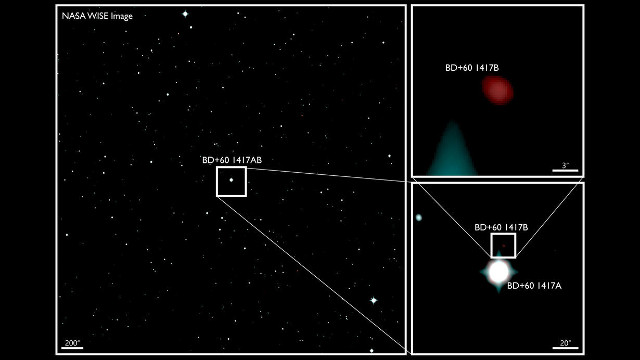
BD+60 1417's system

An article published in “The Astrophysical Journal” reports the discovery of an object orbiting BD+60 1417, a young star a little smaller than the Sun, which could be a gas giant planet but also a small brown dwarf. Amateur astronomer Jörg Schümann spotted a moving object by examining images in the “Backyard Worlds: Planet 9” program that anyone can participate in. A team led by Jackie Faherty of the American Museum of Natural History used various telescopes to confirm the existence of the object, cataloged as CWISER J124332.12+600126.2 or simply W1243. Its mass was estimated between 10 and 20 times the planet Jupiter’s, around the border between planet and brown dwarf, estimated around 13 Jupiter masses. The object had escaped previous research probably because its distance from its star is about 1660 times that of the Earth from the Sun.