Complex organic molecules discovered around a protostar at the edge of the Milky Way
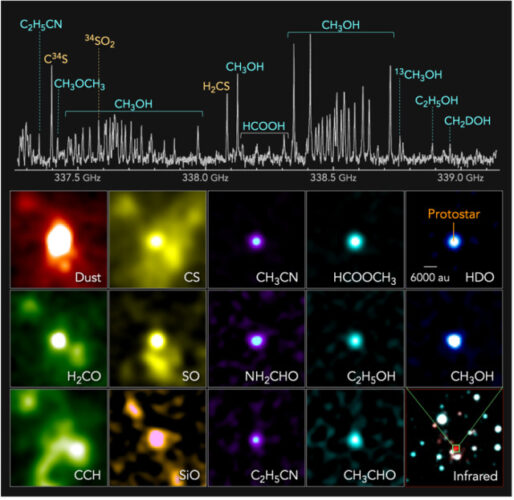
An article published in “The Astrophysical Journal” reports the discovery of complex organic molecules around a protostar at the edge of the Milky Way. A team of researchers led by astronomer Takashi Shimonishi of the Niigata University, Japan, used the ALMA radio telescope to examine the area around a protostar in the region cataloged as WB89-789 detecting the presence of molecules such as methanol, ethanol, methyl formate, dimethyl ether, formamide, propanenitrile, and others. This is the first time that complex organic molecules, the kind that can form prebiotic molecules, have been discovered at the edge of the Milky Way, and this suggests that they can form with an efficiency similar to that existing within the galaxy, in the Sun’s “neighborhood”.