
2021

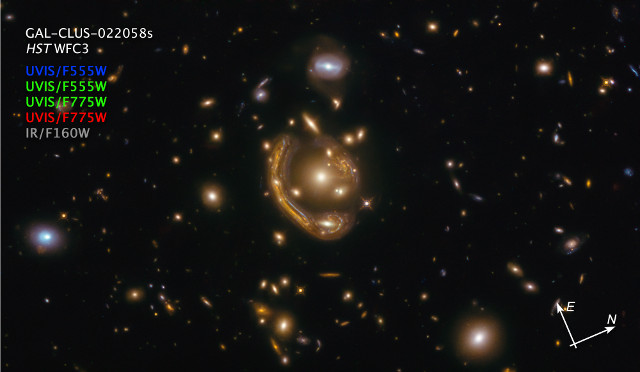
The Molten Ring seen by Hubble (Image Anastasio Díaz-Sánchez (Universidad Politécnica de Cartagena))

An article published in “The Astrophysical Journal” reports a study on the Einstein ring nicknamed the Molten Ring for its “liquid” appearance and because it was identified in the constellation of the Furnace. A team of researchers used observations made with the Hubble Space Telescope and the FORS 2 instrument on the VLT in Chile of the object formally classified as GAL-CLUS-022058s to study its physical characteristics. The ring is actually a galaxy whose light has been distorted by a gravitational lens and, according to the study’s conclusions, is about 9.4 billion light-years away from Earth.


Molecules mapped in the protoplanetary disks around the stars AS 209 and HD 163296

A series of articles published in the “Astrophysical Journal Supplement Series” reports the detection of organic molecules potentially important for the birth of life forms in some protoplanetary disks. A team of researchers used the ALMA radio telescope as part of the MAPS program. ALMA made it possible to detect the emissions of molecules such as cyanoacetylene, acetonitrile, and cyclopropenylidene in the disks of young stars IM Lupi, GM Aurigae, AS 209, HD 163296, and MWC 480. These organic compounds are precursors of more complex molecules important in biological processes and some of them are similar to those that formed in the solar system.

The launch of the Tianzhou 3 cargo spacecraft (Photo courtesy CASC)

Yesterday, the Chinese cargo spacecraft Tianzhou 3 reached the Chinese space station’s Tianhe core module. It was launched about 6.5 hours earlier on a Long March-7 Y4 rocket from the Wenchang base. This is the second cargo spacecraft launched to the new Chinese space station and carries propellant along with supplies of various kinds for the taikonauts, as the Chinese call their astronauts, who will arrive in October.

The Crew Dragon Resilience spacecraft splashing down (Photo courtesy Inspiration4 / SpaceX)

A few hours ago, SpaceX’s Crew Dragon Resilience spacecraft concluded its Inspiration4 mission splashing down without problems. Onboard were Jared Isaacman, Sian Proctor, Hayley Arceneaux, and Chris Sembroski, who finished the first completely private space mission in the Atlantic Ocean not far from Cape Canaveral. Shortly after the splashdown, the SpaceX ship called “Go Searcher” went to retrieve the Crew Dragon and its crew to transport them to the coast.

The Shenzhou 12 capsule after landing (Photo courtesy Xinhua/Ren Junchuan)

A few hours ago, the three Chinese taikonauts of the Shenzhou 12 mission returned to Earth after spending about three months on the Chinese space station’s Tianhe core module. Nie Haisheng, Liu Boming, and Tang Hongbo had left Tianhe about a day earlier to land at a site called Dongfeng in China’s Inner Mongolia Autonomous Region. It was the longest Chinese space mission completed so far but the next missions to the Chinese space station are expected to last six months.