2021

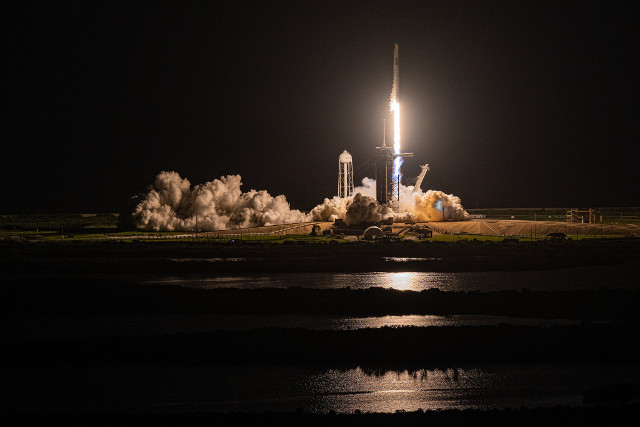
The Crew Dragon Resilience spacecraft blasting off in the Inspiration4 mission (Photo courtesy Inspiration4 / John Kraus)

A few hours ago, SpaceX’s Crew Dragon Resilience spacecraft blasted off atop a Falcon 9 rocket from the Kennedy Space Center in the Inspiration4 mission. After about eleven minutes it successfully separated from the rocket’s last stage. It will spend three days in orbit for the first completely private crewed space mission. It opens a further frontier for space tourism but is also linked to a charity campaign for the American St. Jude hospital in Memphis.

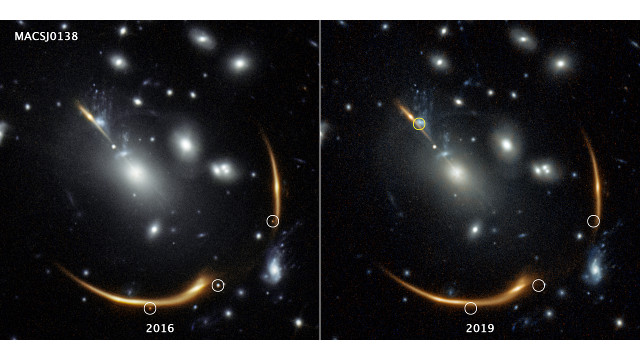
The galaxy cluster MACS J0138.0-2155 and the Requiem supernova

An article published in the journal “Nature Astronomy” reports a study on a supernova whose glow was distorted and multiplied by a gravitational lens. A team of researchers examined various images captured over the years by the Hubble Space Telescope after three images of the supernova AT 2016jka, dubbed Requiem, were discovered in 2016 archival data. As it’s normal, its brightness faded away until it disappeared but, according to the researchers, a fourth image of that supernova will be visible in 2037, again due to the distortion generated by the gravitational lens produced by the force of gravity of the galaxy cluster MACS J0138.0-2155, or simply MACS J0138.

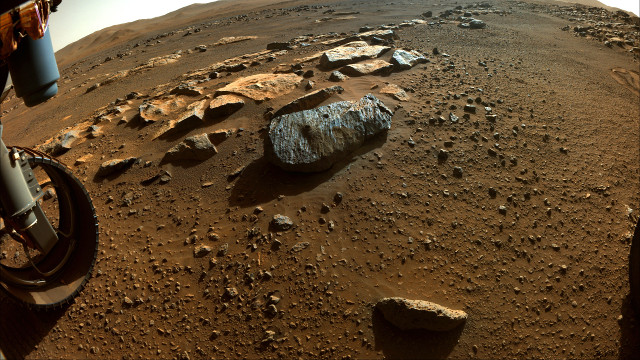
The Rochette rock (Image NASA/JPL-Caltech)

NASA has published the first results of the examination of the first two rock samples collected in recent days by the Mars Rover Perseverance in the Jezero crater on planet Mars. After last month’s disappointment, with the failure of the first attempt to take a sample of a rock that proved too crumbly, there were two successes. A rock nicknamed Rochette proved suitable and Perseverance was successful in taking a sample nicknamed Montdenier on September 6 and a sample nicknamed Montagnac on September 8. The most interesting indication is that there was water in the area for a long time when the environment was potentially habitable.

A representation of the solar system up to the Kuiper Belt

An article published in “The Planetary Science Journal” reports a study on some Kuiper Belt Objects (KBOs) that are part of a particular group of which new observations revealed a blue color and a binary nature. A team of researchers used observations ran by the Col-OSSOS team which obtained color measurements of 98 Kuiper Belt Objects while also offering new insights into the subgroup of objects called cold classical Kuiper Belt Objects. Their conclusion is that the blue binary objects were pushed into that area by Neptune as it moved away from the Sun.

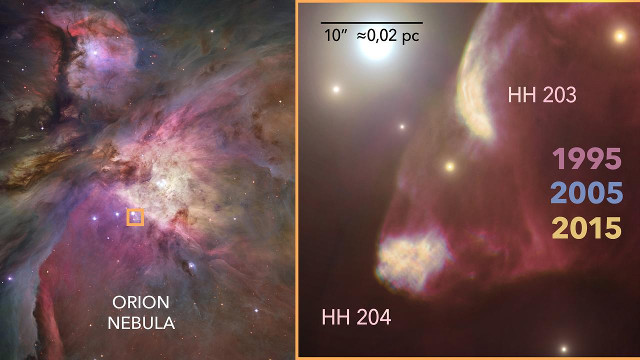
The Orion Nebula seen by the Hubble Space Telescope and on the right the zoom of HH204 with its jet of materials

An article published in “The Astrophysical Journal” reports a study that reveals in detail never before seen the physical and chemical effects of the impact of a protostellar jet in the Orion Nebula. A team of researchers led by José Eduardo Méndez Delgado, a doctoral student at the Instituto de Astrofísica de Canarias (IAC), used observations conducted with the VLT and twenty years of images from the Hubble Space Telescope. This made it possible to examine the impact of the protostellar jet emitted by the object cataloged as HH204 on the surrounding environment and the consequent changes in the density and temperature of the gas in the Orion Nebula. This in turn caused an increase in the gas level of atoms of heavy elements such as iron and nickel.