2021

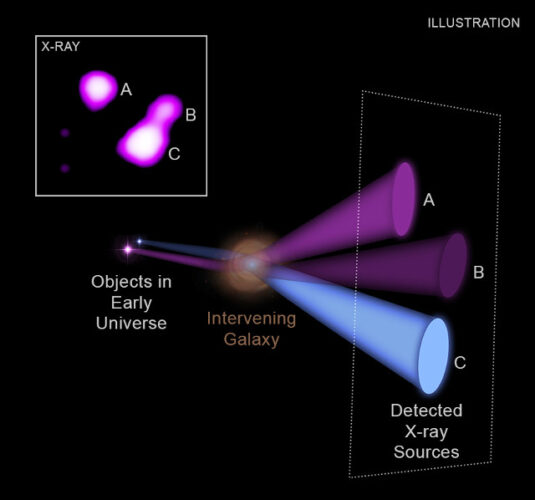
Illustration of MG B2016+112

An article published in “The Astrophysical Journal” reports a study on a double X-ray source in the early universe cataloged as MG B2016+112 which could be composed of two supermassive black holes whose image is distorted by a gravitational lens. Cristiana Spingola, Daniel Schwartz, and Anna Barnacka started from a survey obtained by NASA’s Chandra X-ray Observatory to examine the double object observed. This is an unprecedented situation because from the Earth we see it as it was when the universe was about two billion years old with the two components separated by only 650 light-years. At present, it cannot be ruled out that it’s a single supermassive black hole and one of its jets of materials whose image was strongly distorted by the gravitational lens.

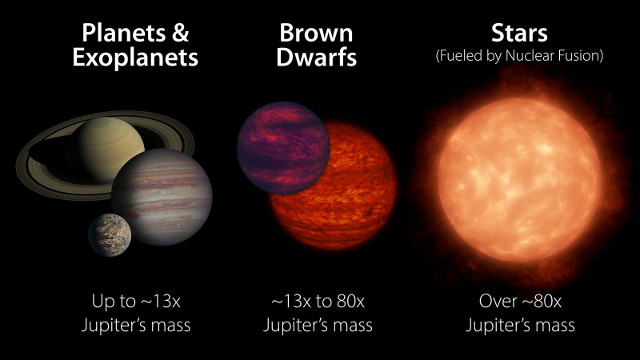
An infographic (NASA/JPL-Caltech) that offers a comparison of the sizes of planets, brown dwarfs, and very small stars

An article published in “The Astrophysical Journal Letters” reports a study on the brown dwarf classified as WISEA J153429.75-104303.3, or simply WISE 1534–1043, nicknamed the Accident because it was discovered purely by chance. A team of researchers used observations conducted with various telescopes to try to understand the characteristics of a brown dwarf different from the ones already known. Its emissions are very dim making it difficult to obtain the desired information but the researchers’ conclusion is that it’s very old, with an age between 10 and 13 billion years, and passed close to much more massive objects that accelerated it until reaching the remarkable speed detected. Its relative proximity to Earth could be random or indicate that brown dwarfs of that type are more common than expected but we can’t detect them with current instruments.

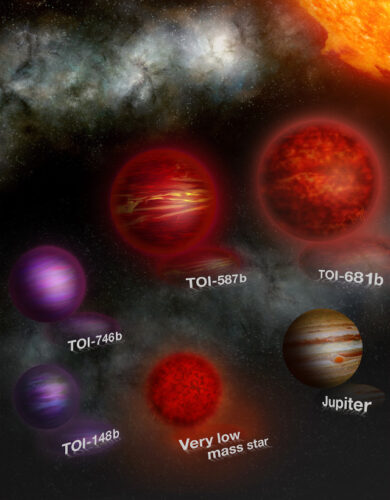
An artistic illustration of these objects together with Jupiter as a size comparison

An article published in the journal “Astronomy & Astrophysics” reports a study on 5 objects on the boundary between brown dwarf and star discovered thanks to NASA’s TESS space telescope. A team of researchers coordinated by a group of Swiss entities conducted follow-up observations of the 5 objects to better understand the nature of brown dwarfs, what distinguishes them from stars, and what is the boundary between these two classes of objects.

The Dragon 2 cargo spacecraft starting its CRS-23 mission blasting off atop a Falcon 9 rocket (Image NASA TV)

A little while ago, the SpaceX Dragon 2 spacecraft blasted off atop a Falcon 9 rocket from the Kennedy Space Center in its CRS-23 (Cargo Resupply Service 23) mission, also referred to as SPX-23. After almost exactly 12 minutes it separated successfully from the rocket’s last stage and went en route. This is the 23rd mission, the 3rd for the Dragon 2 version, for the Dragon spacecraft to resupply the International Space Station with various cargoes and then return to Earth, again with various cargoes.