2021

Artist's concept of the surface a Hycean planet (Image courtesy Amanda Smith, University of Cambridge)

An article published in “The Astrophysical Journal” reports a study that proposes a new type of habitable planet that was named Hycean. Nikku Madhusudhan, Anjali AA Piette, and Savvas Constantinou of the British University of Cambridge’s Institute of Astronomy started from the study of the exoplanet K2-18b to argue that some planets with conditions between those of super-Earths and mini-Neptunes can be covered in oceans and have hydrogen-rich atmospheres offering the possibility of developing carbon-based life forms. These Hycean planets could potentially be habitable even orbiting outside what is commonly considered ​​a star system habitable zone.

Asteroid 2021 PH27 seen in two different moments

The announcement came of the discovery of asteroid 2021 PH27, which has the shortest orbital period among the known asteroids with about 113 Earth days. Astronomer Scott S. Sheppard of the Carnegie Institution of Science identified it in data collected by the Dark Energy Camera (DECam), an instrument designed for cosmological research that on several occasions has also proved useful for other astronomical research. In this case, the images were captured by Ian Dell’Antonio and Shenming Fu of Brown University on August 13, 2021. The orbit of 2021 PH27 is probably not stable over the long period, and studying this asteroid will help to understand the movements of objects with orbits close to that of the planet Mercury.

Fragments of comet C/2019 Y4 (ATLAS) seen by Hubble

An article published in the “Astronomical Journal” reports the results of a study on comet C/2019 Y4 (ATLAS) whose conclusion is that it’s a fragment of a larger comet whose passage could have been seen on Earth about 5,000 years ago. A team of researchers led by astronomer Quanzhi Ye of the University of Maryland in College Park used observations conducted with the Hubble Space Telescope to examine this comet and its orbit. In fact, there are now various fragments and it’s possible that the progenitor gave rise to an entire family of comets. Amateur astronomer Maik Meyer identified a correlation with C/1844 Y1, nicknamed the Great Comet of 1844.

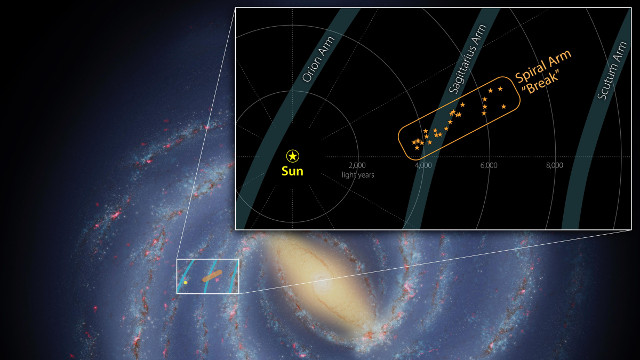
A reconstruction of the Milky Way, the Sagittarius Arm and its "splinter"

An article published in the journal “Astronomy & Astrophysics” reports the discovery of an anomalous structure in the Milky Way’s Sagittarius Arm. A team of researchers used observations made with NASA’s Spitzer Space Telescope and data collected by ESA’s Gaia space probe to locate a structure about 3,000 light-years long that has an orientation that’s very different from the rest of the Sagittarius Arm. Such structures have been identified in other galaxies but it’s the first time that one of them has been identified within the Milky Way. That’s not a surprise, as it’s difficult to study such large structures of the galaxy from the inside.

The galaxy Hercules A

A series of ten articles to be published in the journal “Astronomy & Astrophysics” reports the results of the activity of the LoFar network with its 70,000 antennas with unprecedented details of various galaxies at radio frequencies. A team of astronomers has published these results consisting of astronomical images obtained by making the most of the LoFar network’s capabilities. This made it possible to obtain images twenty times sharper than the previous ones generated by LoFar.