2021

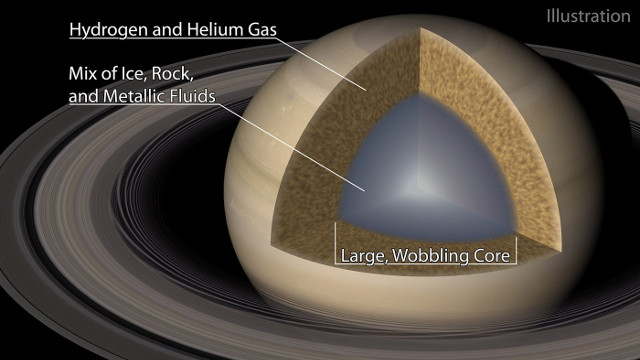
The possible structure of Saturn (Image courtesy Caltech/R. Hurt (IPAC))

An article published in the journal “Nature Astronomy” reports a study on the planet Saturn’s core. Caltech astronomers Christopher Mankovich and Jim Fuller analyzed data collected by the Cassini space probe on the oscillations of Saturn’s rings caused by the internal seismic activity to indirectly analyze the characteristics of the planet’s interior. The conclusion is that the core is not rocky but a mixture that has been compared to a soup or a sludge composed of ice, rock, and metallic fluids that fill a volume for about 60% of Saturn’s diameter, far more than it was previously estimated.

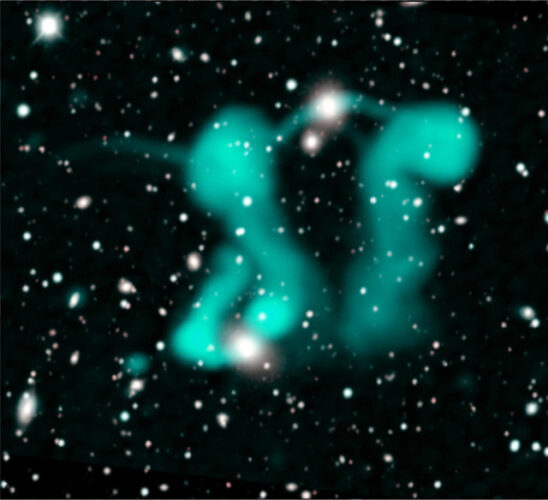
The dancing ghosts seen by ASKAP

An article accepted for publication in the journal “Publications of the Astronomical Society of Australia” reports the first results of the EMU (Evolutionary Map of the Universe) survey, which allowed to discover several objects and phenomena. One of those phenomena is made by strange clouds of electrons surrounding two galaxies about a billion light-years from Earth. This survey was conducted using the ASKAP radio telescope and led to the cataloging of about 220,000 sources including the electron clouds that were compared to dancing ghosts due to their curious shape.

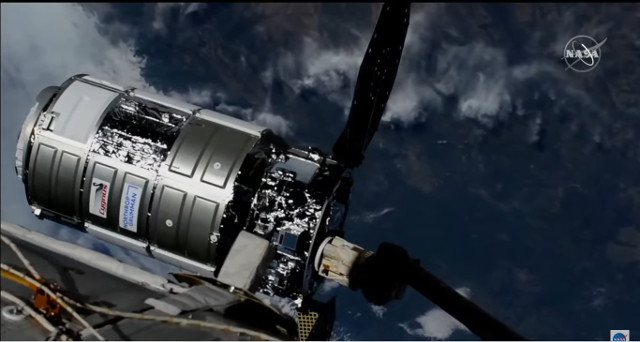
The Cygnus S.S. Ellison Onizuka captured by the Canadarm2 robotic arm (Image NASA TV)

Northrop Grumman’s Cygnus spacecraft, launched last Tuesday, August 10, has just reached the International Space Station and was captured by the Canadarm2 robotic arm. Astronaut Megan McArthur, assisted by her colleague Thomas Pesquet, will soon begin the slow maneuver to move the Cygnus until it docks with the Station’s Unity module after about two hours.

The Cygnus S.S. Ellison Onizuka cargo spacecraft blasting off atop an Antares rocket (Photo NASA’s Wallops Flight Facility/Jamie Adkins)

A few hours ago, Northrop Grumman’s Cygnus spacecraft blasted off atop an Antares rocket from the Mid-Atlantic Regional Spaceport (MARS), part of NASA’s Wallops Flight Facility (WFF) on Wallops Island. After about nine minutes it successfully separated from the rocket’s last stage went en route to its destination. This is its 16th official mission, called NG-16 or CRS NG-16, to transport supplies to the International Space Station for NASA.

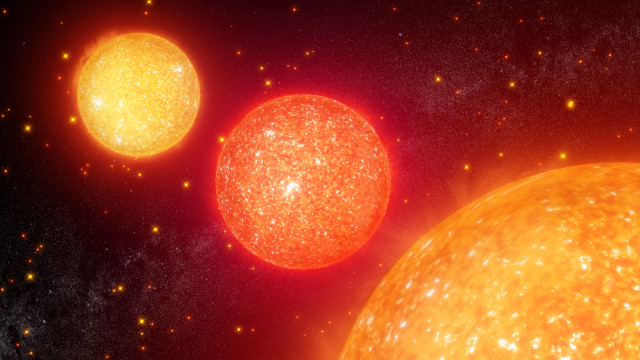
Artist's concept of red giants (Image NASA’s Goddard Space Flight Center/Chris Smith (KBRwyle))

An article accepted for publication in “The Astrophysical Journal” reports the discovery of a total of 158,505 pulsating red giants. A team of researchers used the map of most of the sky created thanks to NASA’s TESS space telescope and, taking advantage of the quality of those observations, identified an unprecedented amount of this type of stars. The map analysis was conducted using a machine learning system trained to detect the traces of the oscillations in the stellar spectra of red giants. This is a very useful result for the studies of astroseismology, a branch of astronomy that studies the structure and properties of stars by analyzing their pulsations. Marc Hon of the University of Hawaii presented the results at the second TESS Science Conference, held virtually in recent days.