
2021

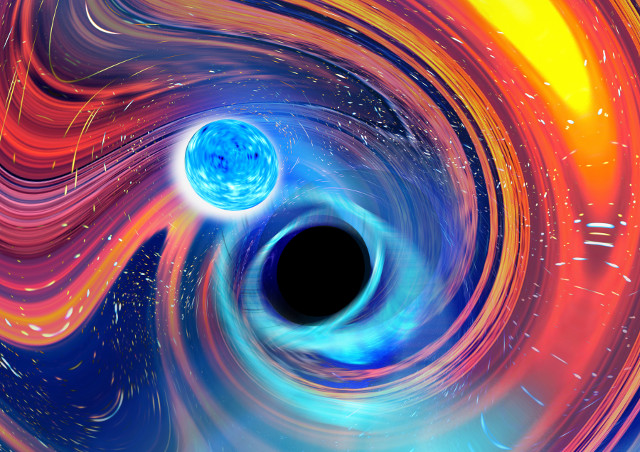
Artist's concept of merger between a black hole and a neutron star. (Image courtesy Carl Knox, OzGrav - Swinburne University)

An article published in “The Astrophysical Journal Letters” reports the detection of gravitational waves emitted by two cases of mergers of a black hole with a neutron star. Scientists from the LIGO, Virgo, and KAGRA collaborations examined data collected by the Advanced LIGO and Advanced Virgo detectors to find evidence of this type of merger in two events detected in January 2020. Previously, there were other candidates but the data left various doubts about the nature of the objects that merged.

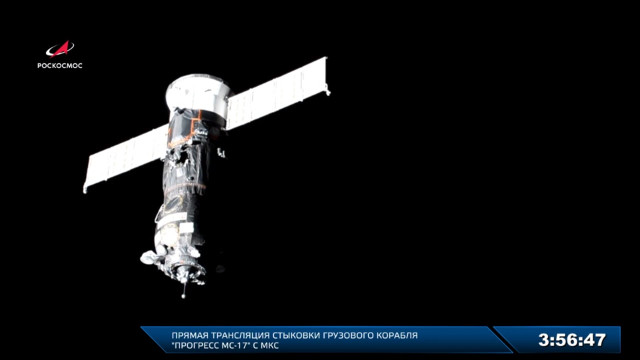
The Progress MS-17 cargo spacecraft approaching the International Space Station (Image courtesy Roscosmos)

A few hours ago, the Progress MS-17 spacecraft docked with the International Space Station in the mission also referred to as Progress 78 or 778. The Russian cargo spacecraft, which blasted off last Tuesday, June 30, carries food, water, scientific experiments, fuel, and various hardware.

The Progress MS-17 cargo spacecraft docked with the International Space Station’s Russian Poisk module. Today, the crew will probably proceed with the hatch opening and the procedures to make the Progress MS-17 an appendage to the Station.

The Progress MS-17 cargo spacecraft blasting off atop a Soyuz-2.1a rocket (Image NASA TV)

A few hours ago, the Progress MS-17 spacecraft blasted off atop a Soyuz-2.1a rocket from the Baikonur Cosmodrome in Kazakhstan. After about nine minutes it successfully separated from the rocket’s last stage and was placed on its route. The cargo spacecraft began its resupply mission to the International Space Station also called Progress 78 or 78P. In this mission, the route used is the one that requires about two days.

The supernova 2018zd, in the white circle on the right, near the galaxy NGC 2146

An article published in the journal “Nature Astronomy” reports a study on the supernova 2018zd. A team of researchers studied observations conducted with various telescopes and concluded that this supernova is of the electron-capture type, which was theorized 40 years ago but never identified with certainty. According to the researchers, 2018zd matches the theoretical predictions and offers new confirmations to the hypothesis that the supernova observed in A.D. 1054 was of the electron-capture type.

RCW 49 (Image NASA/JPL-Caltec/E.Churchwell (University of Wisconsin))

An article published in “The Astrophysical Journal” reports a study concerning a stellar nursery inside the RCW 49 nebula. A team of researchers coordinated by the University of Maryland used data obtained with the SOFIA flying telescope and combined them with others obtained with other instruments to obtain a 3D reconstruction of a gigantic structure of ionized hot plasma that is expanding around the open star cluster Westerlund 2. The main “suspect” behind that expansion is the star WR 20a.