
2021

The Starship SN15 prototype blasting off (Image courtesy SpaceX)

It was yesterday afternoon in Boca Chica, Texas, when SpaceX conducted the flight test of the Starship prototype identified as SN15, the fifth after the one conducted on March 30, 2021. Clouds and some problems with the signal from the onboard cameras prevented seeing the various maneuvers performed by SN15 but the important thing is that it managed to land successfully without suffering damage that could cause its explosion. Flames were seen at the base of SN15 but got extinguished.

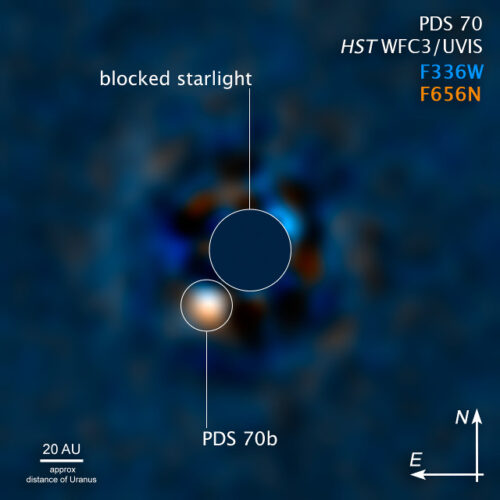
The PDS 70 system seen by Hubble

An article published in “The Astrophysical Journal” reports the first estimates of the growth of a young gas giant exoplanet. A team of researchers used observations conducted with the Hubble Space Telescope of the exoplanet PDS 70b exploiting its sensitivity to ultraviolets emitted by hot gas that gets swallowed by the young giant. This study opens the door to new possibilities for estimating the growth of gas giant planets.

SpaceX's Crew Dragon Resilience spacecraft on the Go Navigator ship (Image NASA TV)

A little while ago SpaceX’s Crew Dragon Resilience spacecraft ended its Crew-1, or SpaceX Crew-1, mission on behalf of NASA by splashing down without problems. Onboard were astronauts Michael Hopkins, Victor Glover, Shannon Walker, and Soichi Noguchi, who finished SpaceX’s first regular crewed mission in the Atlantic Ocean off the coast of Panama City, Florida. The Crew Dragon left the International Space Station about 6.5 hours earlier. Shortly after splashing down, the SpaceX ship called “Go Navigator” went to retrieve the Crew Dragon and its crew to transport them to the coast.

Artist’s concept of Proxima Centauri during a superflare (Image NRAO/S. Dagnello)

An article published in “The Astrophysical Journal Letters” reports an analysis of a superflare of the star Proxima Centauri observed in 2019 in various bands of the electromagnetic spectrum. A team of researchers led by Meredith MacGregor of the University of Colorado at Boulder used various ground-based and space telescopes to obtain complete observations of a flare one hundred times more powerful than solar flares on the closest star to the Sun. It’s the most powerful flare ever observed on Proxima Centauri and one of the most powerful observed in the entire Milky Way.