2021

AG Carinae (Image NASA, ESA and STScI)

A new photo of AG Carinae, a hypergiant star that belongs to the Luminous Blue Variable (LBV) class, captured by the Hubble Space Telescope has been released to celebrate the 31st anniversary of Hubble being deployed into orbit. The star is surrounded by a nebula formed by materials ejected from the star itself in a period in which instability caused one or more extremely powerful outbursts. The shell that was created is about five light-years across.

SpaceX's Crew Dragon Endeavour spacecraft docked to the International Space Station (Image NASA TV)

A little while ago, SpaceX’s Crew Dragon Endeavour spacecraft docked to the International Space Station’s Harmony module completing the first part of its Crew-2 or SpaceX Crew-2 mission that began yesterday with its launch. After checking that the pressure is correctly balanced, the hatch will be opened to allow Thomas Pesquet, Megan McArthur, Shane Kimbrough, and Akihiko Hoshide to enter the Station.

SpaceX's Crew Dragon Endeavour spacecraft blasting off atop a Falcon 9 rocket (Image NASA TV)

A little while ago, SpaceX’s Crew Dragon Endeavour spacecraft blasted off atop a Falcon 9 rocket from Cape Canaveral in its Crew-2 o SpaceX Crew-2 mission. After about eleven minutes, it successfully separated from the rocket’s last stage and went en route to carry out its mission. This is the second crewed mission of the Crew Dragon spacecraft within the normal rotation of the International Space Station crew, the third one overall. This is also the second mission for the Endeavour, used also for the SpX-DM2 mission.

The Ingenuity helicopter's shadow (Photo NASA/JPL-Caltech)

Yesterday, the Ingenuity helicopter conducted its first flight on planet Mars. The duration was only 40 seconds and it reached an altitude of just over 3 meters but it was important to lift off the ground this drone built to test the technologies needed to fly a vehicle in the Martian atmosphere, which is very thin. The flight was autonomous, pre-scheduled, and initiated by a command launched from Earth. The images, along with telemetry data, were transmitted to the Mars Rover Perseverance mission control center.

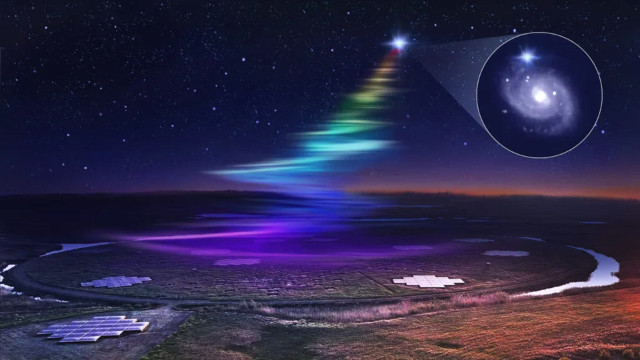
Artistic concept of the LOFAR radio telescope and fast radio burst FRB 20180916B (Image courtesy D. Futselaar / S.P. Tendulkar / ASTRON)

Two articles, one published in “The Astrophysical Journal Letters” and one published in “Nature Astronomy”, report various aspects of a research on the fast radio burst FRB 20180916B, whose emissions include the lowest frequencies at which such an event has been detected so far. Two teams of researchers with various members in common used detections obtained with the LOFAR radio telescope and the European VLBI network to study this fast radio burst that is repeating with a periodicity of just over 16 days. Its origin has been pinpointed in a small region around a neutron star.