2021

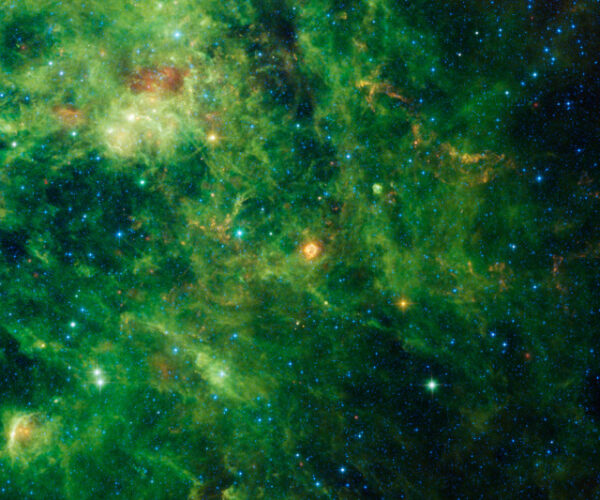
The supernova remnants Cassiopeia A (Image NASA/JPL-Caltech/UCLA)

NASA has released an image of the supernova remnants Cassiopeia A, or simply Cas A, captured by the WISE space telescope at infrareds. There’s no historical record of that supernova even though its light reached Earth around 1667 A.D., probably because a large amount of dust between it and the Earth greatly dimmed its brightness. Its various emissions made it possible to study it with different instruments over the last few decades. WISE detected the echoes of the light burst that are generating ripples outwards from the star that exploded.

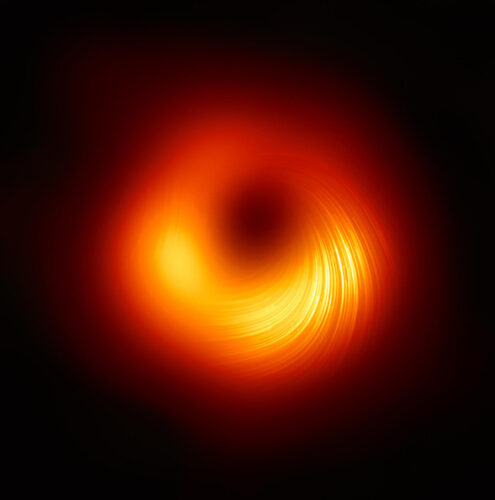
The area around the supermassive black hole of the galaxy M87 in polarized light

Two articles published in “The Astrophysical Journal Letters” report different aspects of a study that led to the representation of the area around the supermassive black hole at the center of the galaxy M87 in polarized light. Scientists from the Event Horizon Telescope Collaboration used data collected in 2017 to obtain a new image that offers new information on the structure of the magnetic fields around the supermassive black hole. A third article published in the same journal reports the details of the observations conducted with the ALMA radio telescope during the 2017 observation campaign.

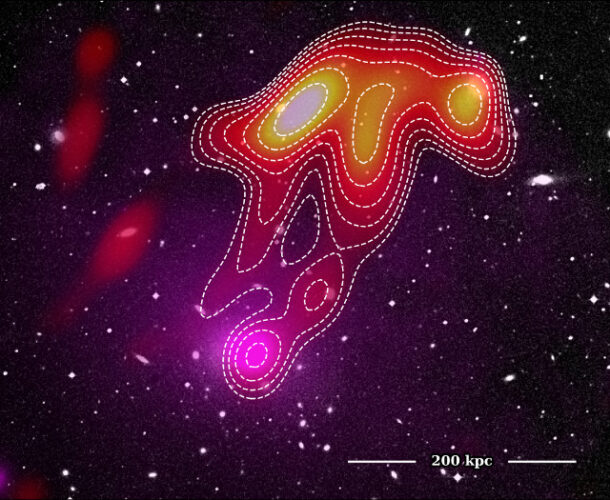
The cosmic jellyfish in the galaxy cluster Abell 2877

An article published in “The Astrophysical Journal” reports a study on the galaxy cluster Abell 2877 conducted with the MWA radio telescope which identified a plasma cloud with a shape similar to a jellyfish. A team led by Torrance Hodgson of the International Center for Radio Astronomy Research (ICRAR) observed Abell 2877 at different radio frequencies and, when they turned the frequency down, they discovered that cosmic structure visible for a short time and only at very few frequencies. It could be plasma ejected about two billion years ago from supermassive black holes in different galaxies that mixed just as shockwaves passed through the cluster, reigniting the plasma for a period that is very short from an astronomical point of view.

Mars dust storm (Image ESA/DLR/FU Berlin, CC BY-SA 3.0 IGO)

An article published in the “Journal of Geophysical Research: Planets” and one published in the journal “Icarus” report two studies that offer new information on the processes of water loss on the planet Mars. Two teams of researchers led respectively by Anna Fedorova of the Russian Academy of Sciences and Jean-Yves Chaufray of the French Laboratoire Atmospheres Observations Spatiales mainly used observations conducted with ESA’s Mars Express space probe’s SPICAM instrument together with data collected from other space probes to study the Martian atmosphere. The conclusion is that seasonal cycles and dust storms are the main causes of the dispersion of water in space. However, some of the water on Mars may still be present in the subsoil as well as in the polar ice caps.

'Oumuamua's artist's representation (Image courtesy William Hartmann)

Two articles published in the “Journal of Geophysical Research: Planets” report as many parts of a research on the interstellar asteroid ‘Oumuamua proposing the theory that it’s composed mainly of solid nitrogen and is a fragment of an exoplanet similar to Pluto. Professor Steven Desch and Dr. Alan Jackson of Arizona State University tried to evaluate the characteristics of different types of ice to see which one best matched the characteristics observed in ‘Oumuamua. Their conclusion is that nitrogen ice would explain this interstellar asteroid’s behavior. According to their reconstruction, between 400 and 500 million years ago, a collision detached a fragment from a planet similar to Pluto and launched it into interstellar space.