2021

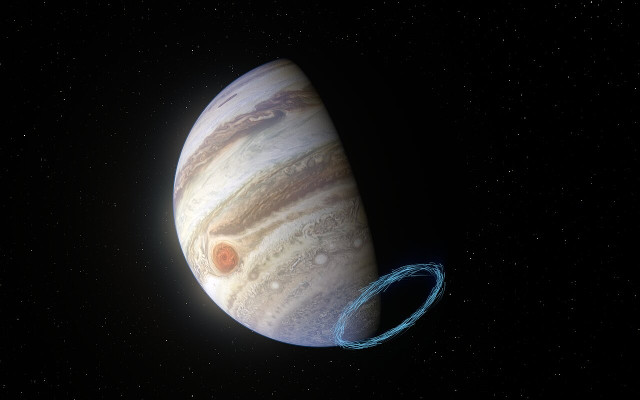
Jupiter and an artistic representation of the winds in its South Pole region

An article published in the journal “Astronomy & Astrophysics” reports the first direct measurement of the speed of winds in the central region of the planet Jupiter’s atmosphere. A team of researchers led by Thibault Cavalié of the Laboratoire d’Astrophysique de Bordeaux in France found a way to measure the velocity of winds in the stratosphere in the area hit by comet Shoemaker–Levy 9 in July 1994. Years later, hydrogen cyanide molecules released into the Jovian atmosphere continue to travel together with the winds, and these movements are detectable in the emissions captured by the ALMA radio telescope. The result is that these winds reach 1450 kilometres an hour near Jupiter’s poles.

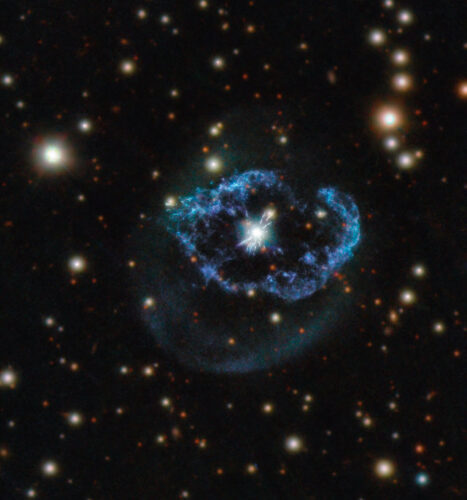
Abell 78 (Image ESA/Hubble & NASA, M. Guerrero. Acknowledgement: Judy Schmidt)

A composite image that combines data obtained from the Hubble Space Telescope and the Pan-STARRS1 telescope in Hawaii shows the details of the planetary nebula Abell 78. It’s rather unusual among planetary nebulae because it’s a so-called born again star whose core stopped nuclear fusion but the density reached by the external layers ejected in a violent way triggered the fusion of helium in them. The consequence is an even more violent ejection of materials that generated the nebula’s irregular shape around the now dying progenitor star.

U Monocerotis

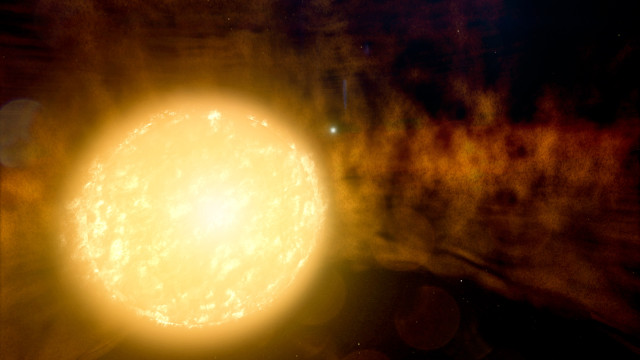
An article published in “The Astrophysical Journal” reports a study on the variable star U Monocerotis conducted by examining data collected over almost 130 years. A team of researchers led by Laura Vega of Vanderbilt University in Nashville, USA, studied what is in fact a binary system using data that goes back to the observations conducted in 1888 and stored in the archives of the American Association of Variable Star Observers (AAVSO). This is the most comprehensive study ever conducted on a variable star, the largest of the pair, a yellow supergiant whose brightness varies over time.

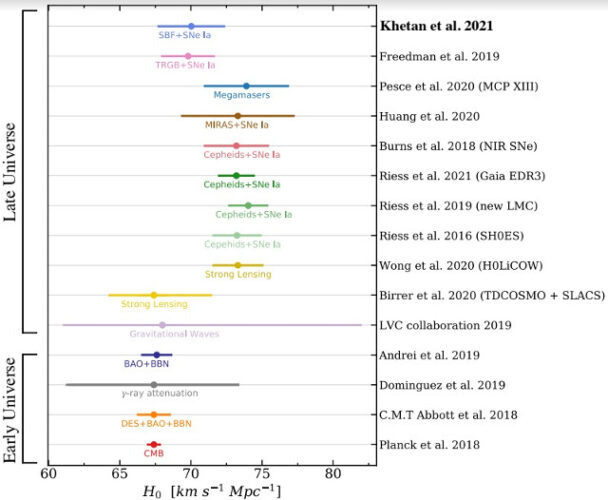
Different values of the Hubble constant

An article published in the journal “Astronomy & Astrophysics” reports a method to measure the expansion velocity of the universe that takes into account the differences between the type Ia supernovae used. A team of researchers led by Nandita Khetan, Ph.D. student at the Italian Gran Sasso Science Institute and associated with the Italian National Institute of Nuclear Physics, proposed a method to calibrate the distances of those supernovae using the surface brightness fluctuations (SBF) of their host galaxies. The result is closer to the ones already calculated with other methods than the one obtained without that calibration. It doesn’t solve the problem of very different values ​​of the so-called Hubble constant but suggests the possibility that the problem is due to instrumental inaccuracies and doesn’t require new physics.

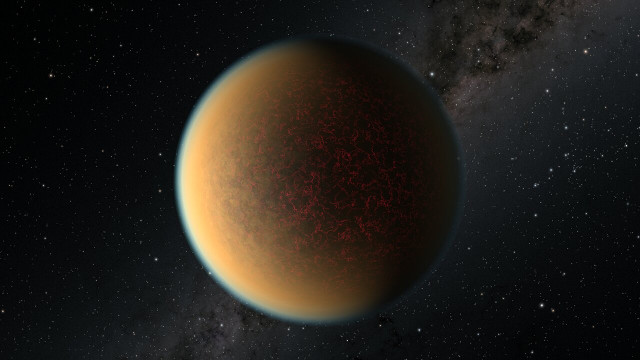
An artist’s impression of the exoplanet GJ 1132 b (Image NASA, ESA, and R. Hurt (IPAC/Caltech))

An article to be published in “The Astronomical Journal” reports a study on the atmosphere of the exoplanet GJ 1132 b which indicates that it may have lost its original atmosphere and that a new one was subsequently formed as a result of volcanic activity. A team of researchers led by Mark Swain of NASA’s Jet Propulsion Laboratory used observations conducted with the Hubble Space Telescope to detect the presence of an atmosphere containing hydrogen, hydrogen cyanide, methane, and ammonia with hydrocarbon hazes. According to the researchers, GJ 1132 b may have originated as a sub-Neptune, lost its original atmosphere because it’s very close to its star and therefore very hot, and what is now being detected is a new atmosphere generated by volcanic activity.