2021

The Cygnus Katherine Johnson cargo spacecraft blasting off atop an Antares rocket (Image NASA TV)

A little while ago, Northrop Grumman’s Cygnus spacecraft blasted off atop an Antares rocket from the Mid-Atlantic Regional Spaceport (MARS), part of NASA’s Wallops Flight Facility (WFF) on Wallops Island. After about nine minutes it successfully separated from the rocket’s last stage went en route to its destination. This is its 15th official mission, called NG-15 or CRS NG-15, to transport supplies to the International Space Station for NASA.

The first image of Mars captured by the Mars Rover Perseverance (Photo NASA/JPL-Caltech)

A few hours ago, the Mars Rover Perseverance and the Ingenuity helicopter landed successfully on Mars, in Jezero Crater. Launched on July 30, 2020, these are the two vehicles of NASA’s Mars 2020 mission. With more than 1,000 kg of weight on Earth, Perseverance even surpasses the Mars Rover Curiosity, of which it’s an evolution. For at least a Martian year, it will examine the area of ​​a geologically very interesting crater, collecting samples that mighy be returned to Earth by a future mission.

The Progress MS-16 spacecraft blasting off atop a Soyuz-2.1a rocket (Image NASA TV)

A few hours ago, the Progress MS-16 spacecraft blasted off atop a Soyuz-2.1a rocket from the Baikonur Cosmodrome in Kazakhstan. After about nine minutes it successfully separated from the rocket’s last stage and was placed on its route. The cargo spacecraft began its resupply mission to the International Space Station also called Progress 77 or 77P. In this mission, the route used is the one that requires about two days.

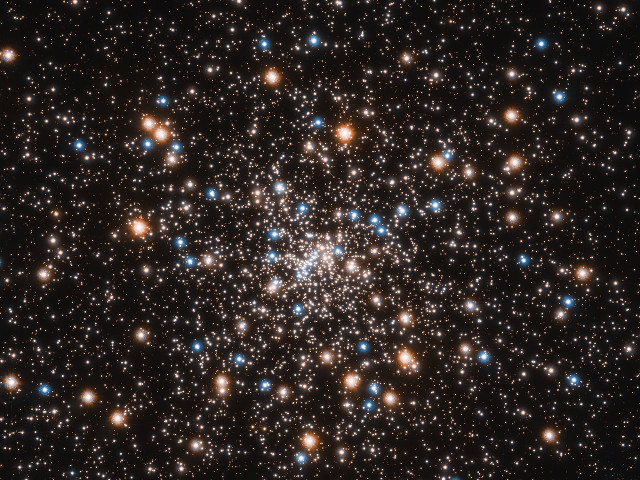
The globular cluster NGC 6397 seen by Hubble (Image NASA, ESA, and T. Brown and S. Casertano (STScI). Acknowledgement: NASA, ESA, and J. Anderson (STScI))

An article published in the journal “Astronomy & Astrophysics” reports evidence of the presence of a group of black holes in the globular cluster NGC 6397. Eduardo Vitral and Gary A. Mamon of the Institut d’Astrophysique de Paris (IAP) used observations conducted with the Hubble Space Telescope and the Gaia space probe to study the core of NGC 6397 expecting to find evidence of the presence of an intermediate-mass black hole that was a hidden mass, but the analyzes of the star movements within the cluster indicated the presence of various stellar-mass black holes.