2021

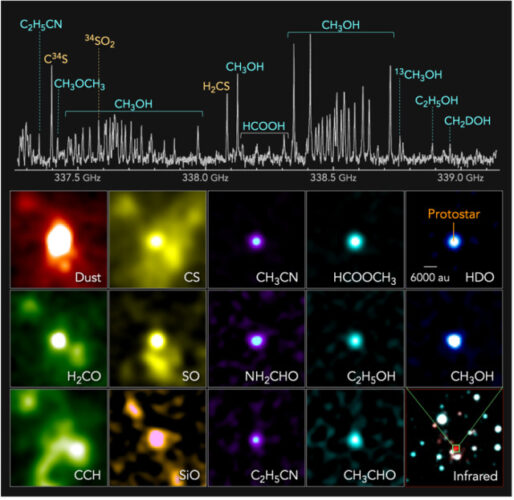
The traces of various molecules in the protostar's emissions seen by ALMA along with an infrared view

An article published in “The Astrophysical Journal” reports the discovery of complex organic molecules around a protostar at the edge of the Milky Way. A team of researchers led by astronomer Takashi Shimonishi of the Niigata University, Japan, used the ALMA radio telescope to examine the area around a protostar in the region cataloged as WB89-789 detecting the presence of molecules such as methanol, ethanol, methyl formate, dimethyl ether, formamide, propanenitrile, and others. This is the first time that complex organic molecules, the kind that can form prebiotic molecules, have been discovered at the edge of the Milky Way, and this suggests that they can form with an efficiency similar to that existing within the galaxy, in the Sun’s “neighborhood”.

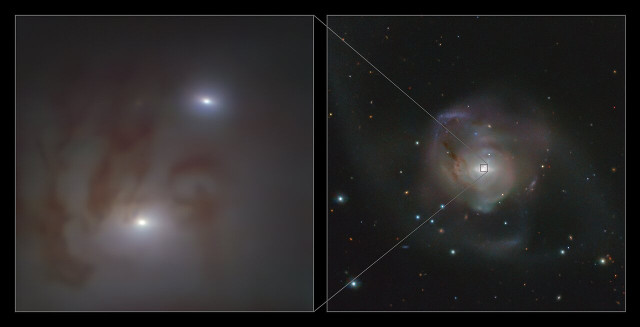
The galaxy NGC 7727 and its pair of supermassive black holes seen by the VLT

An article published in the journal “Astronomy & Astrophysics” reports the detection of a pair of supermassive black holes in the galaxy NGC 7727. A team of researchers used ESO’s VLT to conduct the observations that led to a discovery that broke two records in this field. The two supermassive black holes are the closest pair discovered so far at about 89 million light-years from Earth and are the closest to each other, as their distance was estimated to be around 1,600 light-years.

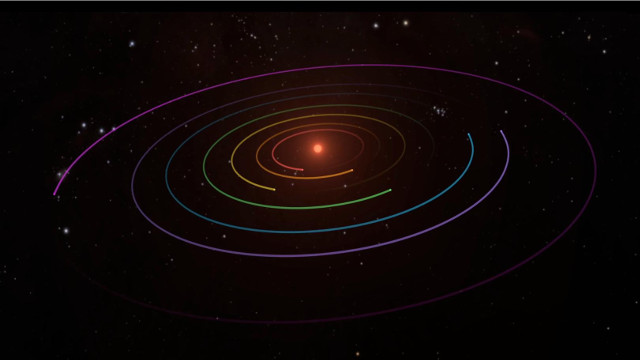
Scheme of TRAPPIST-1 planets' orbits (Image NASA/JPL-Caltech)

An article published in the journal “Nature Astronomy” reports a study on the formation of the planets of the ultra-cool star TRAPPIST-1’s system. A team of researchers exploited the particular configuration of the seven rocky planets to calculate how long their formation may have taken, obtaining a maximum value of a few million years, only a tenth of the time it took for the Earth to form. That’s because the resonance that exists between the planets can only have been maintained in the absence of a late bombardment of the kind that occurred in the solar system that completed its planets’ formation. One consequence is that water must have been absorbed by TRAPPIST-1’s planets during their formation in the protoplanetary disk.

The Prichal module docked with the International Space Station (Image NASA TV)

Yesterday, the Russian Prichal module, also known as Uzlovoy Module (UM), docked with the International Space Station’s Nauka/MLM module becoming part of the Russian section. Prichal was launched on November 24 and flown to the Station by a modified Progress cargo spacecraft. Once the task to make it fully operational is completed, it will provide five more docking hatches.

The Prichal module blasting off atop a Soyuz 2.1b rocket (Photo courtesy RSC Energia)

Yesterday, the Russian Prichal module, also known as Uzlovoy Module (UL), was launched atop a Soyuz 2.1b rocket from the Baikonur Cosmodrome, Kazakhstan. After a little more than nine minutes, it successfully separated from the rocket’s last stage and set off on its course. Its journey will take just over two days to reach the International Space Station, on November 26, where it will become part of the Russian section many years behind schedule. Prichal will be driven to its destination by a modified Progress cargo spacecraft.