2021

The DART spacecraft blasting off atop a Falcon 9 rocket (Image NASA)

A few hours ago, NASA’s DART mission was launched on a Falcon 9 rocket from the Vandenberg base. After about 56 minutes, the spacecraft successfully separated from the rocket’s last stage and set off on its way to reaching the binary asteroid Didymos to attempt to change the orbit of its satellite Dimorphos. The impact should take place in September 2022 and be monitored from Earth and the Italian Space Agency’s LICIACube nanosatellite launched together with the space probe.

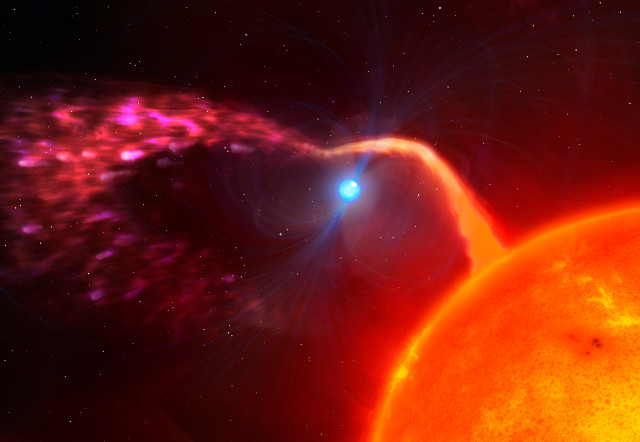
Artist concept of J0240+1952 and its companion (Image courtesy University of Warwick/Mark Garlick)

An article published in the journal “Monthly Notices of the Royal Astronomical Society: Letters” reports the discovery of the white dwarf with the fastest known rotation speed. A team of researchers used the HiPERCAM instrument mounted on the Gran Telescopio Canarias (GTC) to measure the rotation speed of the white dwarf cataloged as Lamost J024048.51+195226.9, or simply J0240+1952. Its rotation in 24.93 seconds makes it the fastest in its class. The examination also made it possible to establish that it’s a magnetic propeller system in which the white dwarf steals gas from a companion and then ejects it into space at very high speeds because of its intense magnetic field.

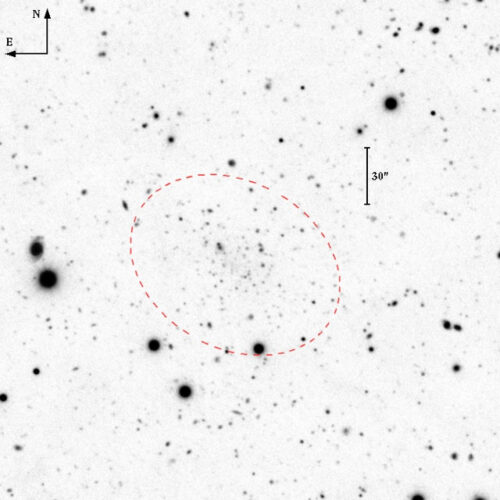
The dwarf galaxy Pisces VII seen by DOLoRes (Image courtesy W. Boschin/TNG)

An article published in the journal “Monthly Notices of the Royal Astronomical” reports the confirmation of the discovery of the dwarf galaxy Pisces VII, which could be a satellite of the Triangulum galaxy. A team of researchers led by David Martínez-Delgado of the Instituto de Astrofisica de Andalucia used the DOLoRes instrument at the Galileo National Telescope to confirm the existence of Pisces VII, originally identified by the amateur astronomer Giuseppe Donatiello. The gravitational bond with the Triangulum galaxy has yet to be verified but if the outcome were positive it would be a confirmation of the theories concerning galaxy formation, which predict the presence of various satellite galaxies. The reference is to the Lambda-CDM model, which also concerns dark matter.

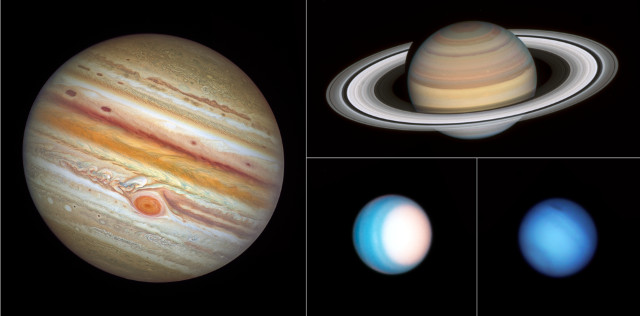
Jupiter, Saturn, Uranus, and Neptune seen by Hubble

A composition of images captured by the Hubble Space Telescope brings together the solar system’s giant planets on a grand tour of the outer planets. Jupiter, Saturn, Uranus, and Neptune are among the targets of periodic observations in programs such as OPAL (Outer Planets Atmospheres Legacy) to keep an eye on the changes that occur over time in their atmospheres. Along with other instruments, which in some cases include space probes, Hubble is an important contributor to studies of gas planets. Programs such as OPAL are also useful in developing models for studying gas exoplanets in other star systems.

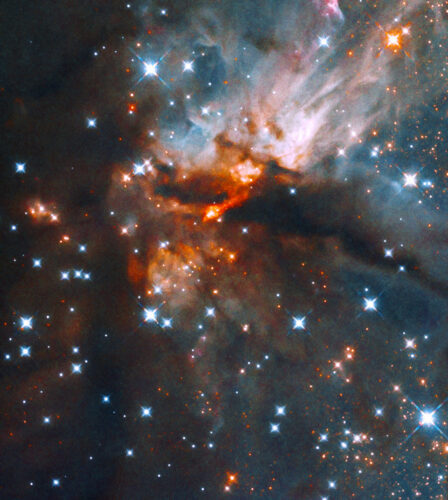
The G035.20-0.74 nebula (Image NASA, ESA, and J. Tan (Chalmers University of Technology); Processing; Gladys Kober (NASA/Catholic University of America))

NASA has released an image captured by the Hubble Space Telescope of the nebula cataloged as G035.20-0.74, a star nursery in the constellation Aquila. In this specific case, the stars that are born are really massive, B-Type blue giants that are up to five times hotter than the Sun. Their formation is among the astronomers’ research objects and within G035.20- 0.74 there’s a massive protostar that is emitting jets of gas. It’s a phenomenon known in protostars but it’s difficult to observe in the ones so massive, which tend to be surrounded by larger quantities of dust that hide them.