2021

Simulations of protoplanetary disks indicate the movements of newborn planets

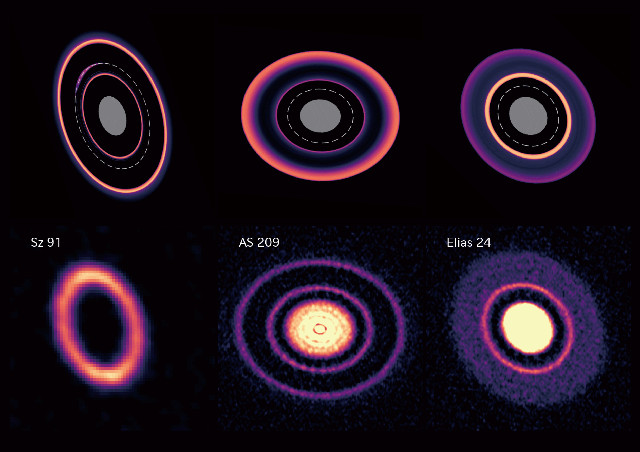
An article published in “The Astrophysical Journal” reports a study on protoplanetary disks that offers a solution to the rarity of the discovery of newborn exoplanets near the rings that form inside them. A team of three Japanese researchers used the ATERUI II supercomputer, the most powerful used in astronomy, to create simulations of planetary systems’ evolution. The results indicate that the planets create rings as they grow but subsequently move away from them.

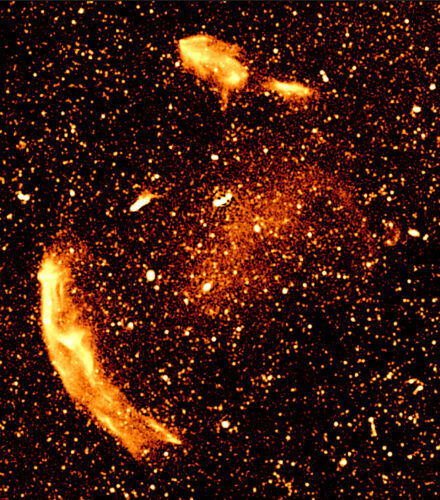
The radio tracks of a powerful merger in progress between two or more massive groups of gas and galaxies in the cluster MCXC J0352.4-7401

An article accepted for publication in the journal “Astronomy & Astrophysics” offers an overview of the results of the MGCLS (MeerKAT Galaxy Cluster Legacy Survey) project, which covers 115 galaxy clusters. A team of researchers led by Kenda Knowles of the University of KwaZulu-Natal, South Africa, used the MeerKAT radio telescope for a total of approximately 1,000 hours of observations to obtain images that were processed and analyzed. These are only the first results of an investigation that can bring new information on the processes taking place in those 115 clusters.

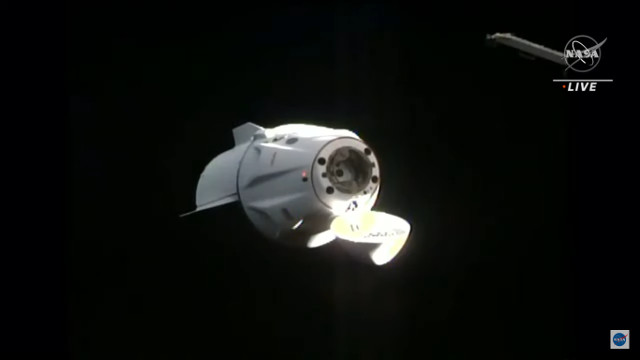
The Crew Dragon Endurance spacecraft approaching the International Space Station (Image NASA TV)

A few hours ago, SpaceX’s Crew Dragon Endurance spacecraft docked to the International Space Station’s Harmony module completing the first part of its Crew-3 or SpaceX Crew-3 mission that began yesterday with its launch. After checking that the pressure is correctly balanced, the hatch will be opened to allow Raja Chari, Thomas Mashburn, Matthias Maurer, and Kayla Barron to enter the Station. The Endurance reached the Station about 40 minutes earlier than the original schedule.

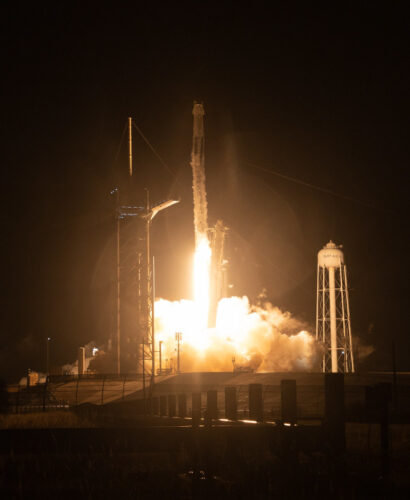
The Crew Dragon Endurance spacecraft blasting off atop a Falcon 9 rocket (Photo NASA/Joel Kowsky)

A few hours ago, SpaceX’s Crew Dragon Endurance spacecraft blasted off atop a Falcon 9 rocket from the Kennedy Space Center in its Crew-3 or SpaceX Crew-3 mission. After about eleven minutes, it successfully separated from the rocket’s last stage and went en route to carry out its mission. This is the third crewed mission of the Crew Dragon spacecraft within the normal rotation of the International Space Station crew. This is also the first mission for the Endurance and is the first to transport rookie astronauts.

The Crew Dragon Endeavour spacecraft departin hte International Space Station (Photo NASA)

A few hours ago, SpaceX’s Crew Dragon Endeavour spacecraft ended its Crew-2, or SpaceX Crew-2, mission on behalf of NASA by splashing down without problems. Onboard were astronauts Thomas Pesquet, Megan McArthur, Shane Kimbrough, and Akihiko Hoshide, who reached the International Space Station on April 24, were part of the Expeditions 65 and 66. They finished SpaceX’s second regular crewed mission in the Atlantic Ocean off the coast of Pensacola, Florida. The Crew Dragon left the International Space Station about 8.5 hours earlier. Shortly after splashing down, the SpaceX ship called “Go Navigator” went to retrieve the Crew Dragon and its crew to transport them to the coast.