2021

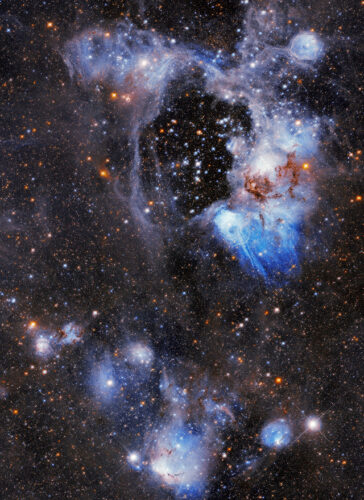
The N44 nebula (Image NASA, ESA, V. Ksoll and D. Gouliermis (Universität Heidelberg), et al.; Processing: Gladys Kober (NASA/Catholic University of America))

NASA has released an image captured by the Hubble Space Telescope of N44, an emission nebula in the Large Magellanic Cloud. Its classification is due to the fact that it glows because of electromagnetic emissions generated by the ionization caused by the stars present in that area. A really curious formation inside it is what was called a superbubble, a kind of cavity inside N44 that’s still without a certain explanation. The stellar winds in the nebula don’t seem to have the necessary characteristics, so the most widely considered hypothesis is that the cavity was excavated by supernovae.

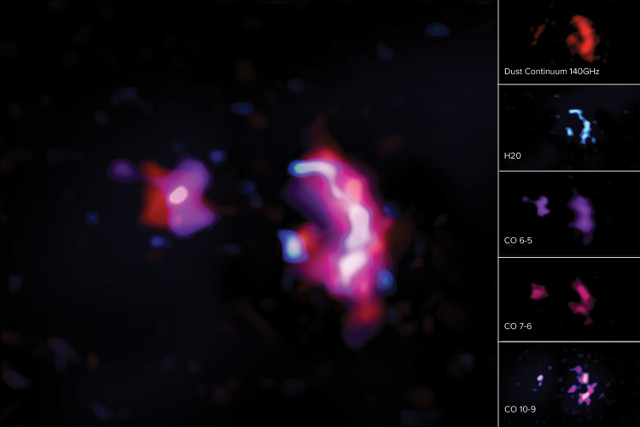
Water and carbon monoxide in the galaxy SPT0311-58 as seen by the ALMA radio telescope

Two articles, one published in “The Astrophysical Journal” and one in “Nature Astronomy”, report as many studies on molecules detected in the early universe thanks to the ALMA radio telescope. A team led by astronomer Sreevani Jarugula of the University of Illinois, USA, detected the presence of water in the galaxy SPT0311-58, about 12.88 billion light-years from Earth, the farthest ever detected in a galaxy without an active galactic nucleus. A team led by Maximilien Franco of the University of Hertfordshire, UK, detected the presence of hydrofluoric acid in the galaxy NGP–190387, about 12 billion light-years from Earth. In this case, the discovery is also important because the mechanisms of fluorine production are not very clear, and detecting their presence when the universe was about 1.4 billion years old indicates that the so-called Wolf-Rayet stars must be an important source of this element.

Three galaxies simulated in the IllustrisTNG Project

An article published in “The Astronomical Journal” reports the first results of an analysis of the data of the Data Release 3 (DR3) of the Lega-C astronomical survey, the largest spectroscopic survey of galaxies that we could define in their midlife since we see them as they were between about five and eight billion years ago. It offers information crucial to fully understand certain phases of the evolution of galaxies and star formation within them. Good news offered by a team of researchers led by Po-Feng Wu of the Institute of Astronomy and Astrophysics in Taipei (Taiwan) is the good consistency between the simulations of the IllustrisTNG program and of the observations conducted in that sort of census that was Lega-C.

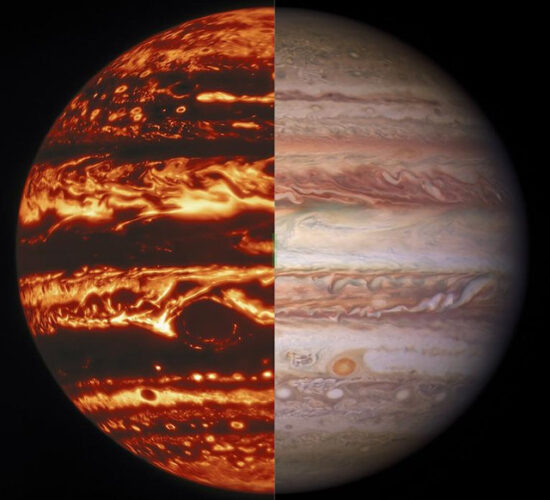
Jupiter seen at infrareds and visible light

Various articles published in the journals “Science”, “Journal of Geophysical Research: Planets”, and “Geophysical Research Letters” report various results of the research conducted on planet Jupiter’s atmosphere. Various teams of researchers used data gathered by NASA’s Juno space probe to obtain various results. For the first time, it’s been possible to create a 3D reconstruction of the Jovian atmosphere that offers a better understanding of how the bands that envelop the planet and are known as belts and zones work, of the polar cyclones, and the Great Red Spot.