
2021

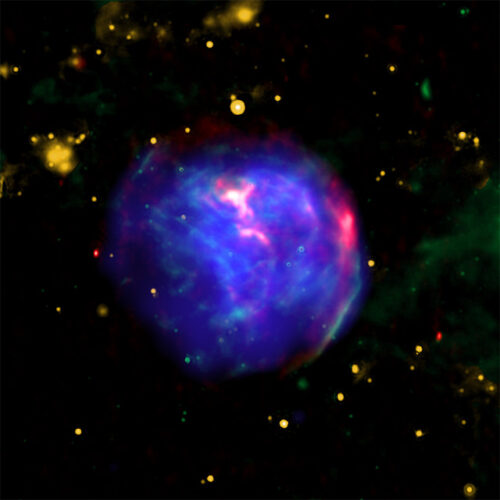
Composite image of G344.7-0.1 (X-ray: NASA/CXC/Tokyo Univ. of Science/K. Fukushima, et al.; IR: NASA/JPL/Spitzer; Radio: CSIRO/ATNF/ATCA)

An article published in “The Astrophysical Journal” reports a study on the supernova remnants cataloged as G344.7-0.1. A team of researchers combined observations in different bands of the electromagnetic spectrum to study the consequences of a Type Ia supernova, the explosion of a white dwarf that reached critical mass after stealing gas from a companion. These remnants can show in particular the effects of what is called reverse shock and offer new information to better understand these supernovae, important in the creation of elements such as iron that are scattered in interstellar space.

Infographic of water vapor's presence in Europa's atmosphere (Image ESA/Hubble, J. da Silva)

An article published in the journal “Geophysical Research Letters” reports the detection of a stable presence of water vapor in the atmosphere of Jupiter’s moon Europa. Lorenz Roth of the Kth Royal Institute of Technology in Stockholm, Sweden, used ultraviolet observations conducted with the Hubble Space Telescope between 1999 and 2015 to infer the presence of water vapor. Its presence appears to be persistent only in one hemisphere of Europa, the one opposite the moon’s direction of motion in its orbit.

The Soyuz MS-18 spacecraft landing (Image NASA TV)

A few hours ago, cosmonaut Oleg Novitskiy, director Klim Shipenko and actress Yulia Peresild returned to Earth on the Soyuz MS-18 spacecraft, which landed in Kazakhstan. Novitskiy spent just over 6 months on the International Space Station, where he arrived on April 9, 2021, as part of Expedition 64. Shipenko and Peresild arrived on October 5, 2021, to shoot a film on the Station in an agreement with the space agency Roscosmos that changed the normal rotation of the Station crew.

The Lucy space probe blasting off atop an Atlas V 401 rocket (Image NASA TV)

A little while ago NASA’s Lucy mission blasted off atop an Atlas V 401 rocket from Cape Canaveral. Almost 58 minutes after launch, the space probe separated regularly from the rocket’s last stage and entered the trajectory that is programmed to lead it towards Jupiter’s orbit, where there are the so-called Jupiter’s Trojan asteroids. There, Lucy will begin a series of flybys on a mission that is expected to last approximately 12 years.

The launch of the Shenzhou 13 mission (Photo courtesy Xinhua)

A confirmation has arrived that the three Chinese taikonauts of the Shenzhou 13 mission have reached the Chinese space station’s Tianhe core module with an automated docking maneuver. They blasted off about six and a half hours earlier on a Long March-2F rocket from the Jiuquan Satellite Launch Center. They’re the second crew of the Chinese space station and will remain there for about six months, twice the length of the Shenzhou 12 mission.