
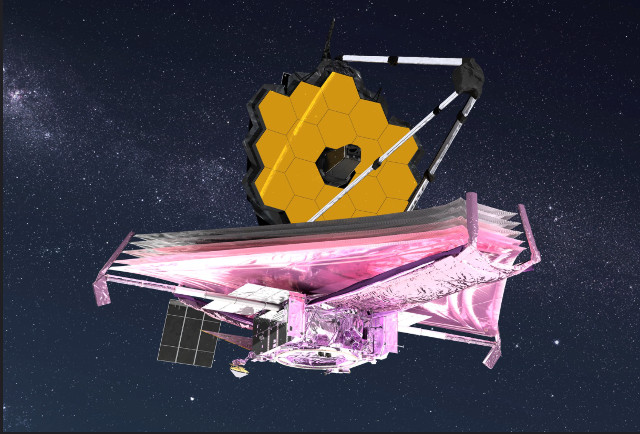
Yesterday, NASA confirmed the successful completion of the deployment of all components of the James Webb Space Telescope. Launched on December 25, 2021, this next-generation space telescope required several days of complex operations to deploy the various structures that make it up to reach its final configuration. This was a crucial phase that also included risks in the event that one of the systems didn’t work properly. Now the new phase opens with the calibration of the instruments, task-intensive to the point that it will take months before the James Webb can finally begin its scientific mission.
Today, there are no rockets capable of launching a spacecraft the size of the James Webb Space Telescope. It has a 6.5-meter primary mirror and its sunshield is just over 20 meters long and just over 14 meters wide. For this reason, its parts were launched folded inside the rocket.
Despite the difficulties, the Ariane 5, one of the most powerful and reliable rockets in service today, accomplished its mission with extreme efficiency. The result is that the James Webb will arrive close to the Lagrange point cataloged as L2 with a greater than expected amount of the fuel it will use to maintain its stability of its orbit and its attitude This means that it will be able to operate without limitations for a significantly longer time.
The deployment of James Webb’s parts took several days. The deployment of the sunshield alone was accomplished in stages over the course of some days because it’s divided into various parts and layers. For each operation, the team that managed the task used all the time necessary to do everything correctly and check that everything was proceeding as planned, with the possibility of stopping in case of problems.
The James Webb has no cameras installed for these tasks because this would have required a specific design in an already very complex machine and the cameras would still have major problems sending useful images due to sunlight. Instead, the team used data sent from the many sensors on the telescope, which were much easier to install.
With the James Webb Space Telescope in its final configuration, it will now be possible to begin the even longer work of calibrating its instruments. The primary mirror is divided into 18 segments equipped with a system of actuators that allow them to be moved with extreme precision and in the next phase, they will be used to align the segments.
Waiting six months for the scientific mission of the James Webb Space Telescope to start is little compared to the 25 years that passed from the beginning of the original project to the launch, with all the delays, changes in the project, and the controversies that accompanied it. The fact that the structures were correctly deployed was a relief for everyone and offers good hopes that, after a very long wait, the results will finally arrive starting in the summer of 2022.
