
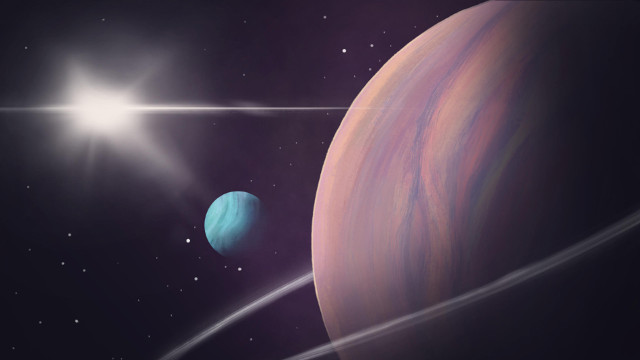
An article published in the journal “Nature Astronomy” reports the discovery of an exomoon candidate that was cataloged as Kepler-1708 b-i. A team of researchers led by David Kipping of Columbia University analyzed data collected by NASA’s Kepler Space Telescope with the specific purpose of looking for possible moons around exoplanets discovered thanks to Kepler. The Jupiter-sized gas giant Kepler-1708 b has a signal indicating the possible presence of a moon that would be a little smaller than the planet Neptune.
Methods of verifying that the detected signal is indeed a moon indicate that there’s only a 1% probability that it’s a false positive but in such a pioneering research field the interpretation of the data can give incorrect results even if mathematically consistent. Surely there will be discussions about this exomoon candidate as there are still about the candidate that could orbit Kepler-1625b in a similar configuration.
About 5,500 light-years from Earth, the star Kepler-1708 is similar to the Sun. The gas giant Kepler-1708 has a distance from its star that makes it an interesting candidate for the search for exomoon like others discovered thanks to the Kepler Space Telescope, the planet hunter whose mission ended in October 2018 leaving a treasure trove in terms of collected data.
David Kipping and his collaborators have been trying for years to locate moons in other planetary systems, a far more difficult feat than locating exoplanets. The transit of a moon in front of a star leaves very little traces, and each candidate requires lengthy analysis to rule out other reasons for those traces. The candidate Kepler-1625b I, announced in July 2017 after rumors leaked, is still under discussion precisely because of the difficulties of identifying with reasonable certainty the origin of those traces.
The new candidate cataloged as Kepler-1708 b-i is similar to the previous one, in the sense that it could be a giant moon nearly the size of Neptune orbiting a gas giant roughly the size of Jupiter. If those really are moons, it’s possible that they were formed as planets and then got captured by more massive planets.
David Kipping’s team analyzed the data about exomoon candidate Kepler-1708 b-i using various methods to try to rule out other sources for the signal. The results indicate that there’s only a 1% chance that it’s a false positive but in such pioneering research these results must always be taken with great caution. Problems such as instrumental errors and inherent errors in the models used to analyze the data can give erroneous results even if mathematically they seem perfectly consistent.
The difficulties in identifying an exomoon are at the root of the still existing discussions about the candidate presented in 2017. For this reason, discussions on the new candidate Kepler-1708 b-i have already begun. Science works like this, with checks by other researchers doing independent analyzes of published data. Now that the James Webb space telescope has finally been launched, it will be possible to obtain higher-quality observations of the systems of the exomoon candidates to take a step forward in this type of frontier of astronomical research.
