
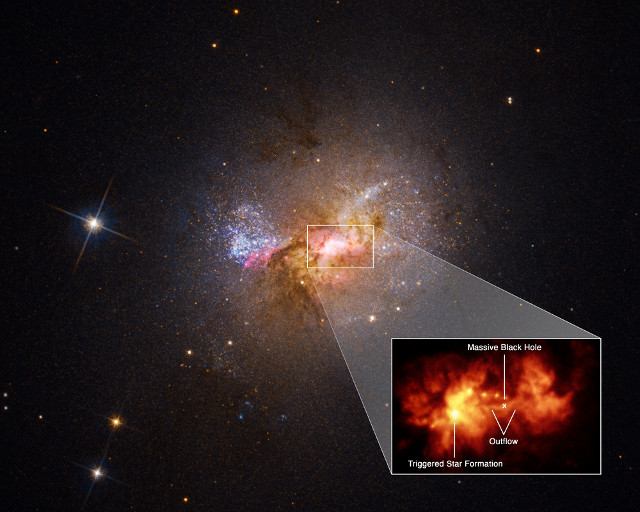
An article – link to the file in PDF format – published in the journal “Nature” reports a study on the dwarf galaxy Henize 2-10 that offers evidence that the supermassive black hole at its center stimulated star formation. Zachary Schutte and Amy Reines relied on observations conducted with the Hubble Space Telescope to find a kind of hot gas bridge that connects the black hole to a region of intense star formation and to connect the black hole’s outflow to that star nursery. These conclusions are useful to understand the influence of supermassive black holes on their host galaxies and their origin.
Just over 30 million light-years from Earth, the dwarf galaxy Henize 2-10 has been the focus of various studies not only for its relative proximity but also for some of its peculiarities that led to various discussions. A doubt related to dwarf galaxies concerns the presence at their center of a supermassive black hole like in bigger galaxies. Certain emissions from Henize 2-10’s center sparked discussions, and in 2011 Amy Reines was part of a team that brought evidence that they came from a supermassive black hole.
Another interesting feature of Henize 2-10 is the intense star formation which places it in the category of starburst galaxies. Amy Reines’ career has been influenced by studies of this unusual dwarf galaxy and for this reason she has become the principal investigator for these new observations conducted with the Hubble Space Telescope. The result is the discovery of a link between the supermassive black hole she identified years ago and a star-forming region about 230 light-years from it.
The image (NASA, ESA, Zachary Schutte (XGI), Amy Reines (XGI). Image processing: Alyssa Pagan (STScI)) shows Henize 2-10 and in the inset details of the area around the black hole with the outflow that comes from it and generates a hot gas bridge that triggered the intense star formation.
According to the reconstruction by Amy Reines and Zachary Schutte, a few million years ago the outflow of hot gas hit the gas cloud in which there was a star nursery and spread inside it. That outflow was compared to water emitted from a hose hitting a mound of dirt. That event increased star formation by compressing the cloud’s gas.
Several studies have been conducted to try to understand the influence of supermassive black holes on their galaxies. The result is that typically the materials that fall towards them form jets of plasma at relativistic speeds whose heat interferes with star formation on their trajectory. The jets from the supermassive black hole at the center of Henize 2-10 are much slower, resulting in the opposite effect.
The mass of the supermassive black hole could make a difference in its effects on the galaxy. The one in Henize 2-10 appears less colossal than the ones in larger galaxies, and this could make its activity less violent. That’s why the researchers refer to it in the article as a massive black hole and not a supermassive one. Its mass hasn’t grown as a result of galaxy mergers as can happen for normal galaxies, and this makes it interesting for the study of the origin of supermassive black holes. It’s one of the objects of discussion among astronomers since it’s very difficult to obtain enough details of primordial galaxies to verify the theories offered so far.
Other dwarf galaxies could show other details of more or less massive black holes and their influence on star formation. Another reason for interest in these extreme objects is that they’re useful to test models in the field of physics to better understand the secrets of the cosmos.
