February 2022

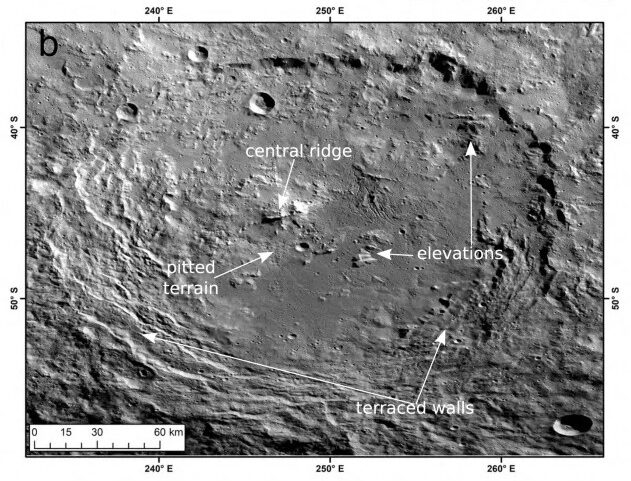
Urvara crater on the dwarf planet Ceres

An article published in the journal “Nature Communications” reports the identification of salts and organic compounds in Urvara crater on the dwarf planet Ceres. A team of researchers used data collected by NASA’s Dawn space probe to conduct the most detailed investigation of Urvara Crater, the third-largest impact crater on Ceres. The results are not surprising and indeed confirm the discoveries of recent years concerning above all the two largest craters, Occator and Ernutet. The famous bright spots that were named faculae in jargon, mysterious before close examinations, shine thanks to the salts they contain, and now the confirmation also arrived for Urvara. This result also confirms the presence at least in the past of an underground ocean in which very salty water remained in a liquid state and perhaps there’s still some.

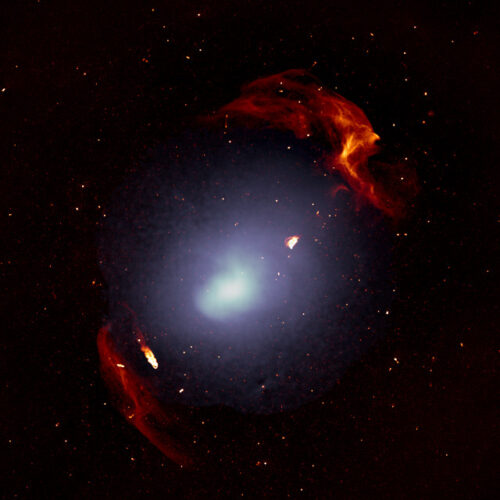
The galaxy cluster Abell 3667

An article published in the journal “Astronomy & Astrophysics” reports the most detailed view ever obtained of remains inside the galaxy cluster Abell 3667 with a shock wave that expands over about 6.5 million light-years, the largest ever identified. A team of researchers led by Francesco de Gasperin of the Italian National Institute of Astrophysics used the MeerKAT radio telescope to obtain detailed images of a shock wave generated by the collision between two galaxy clusters that occurred over a billion years ago.

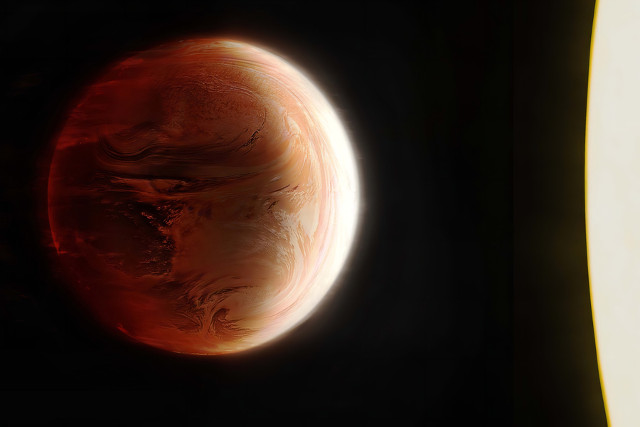
Artist's concept of the exoplanet WASP-121b (Image Engine House VFX)

An article published in the journal “Nature Astronomy” reports the results of a new study on the exoplanet WASP-121b, an ultrahot Jupiter considered one of the planets with the most extreme conditions known. A team of researchers led by Tom Evans, today at the Max Planck Institute for Astronomy in Heidelberg, Germany, used data collected by the Hubble Space Telescope to investigate compounds present in WASP-121b’s atmosphere. The conclusion is that there may be clouds of iron, titanium, and corundum, the crystallized form of aluminum oxide that makes up rubies and sapphires.

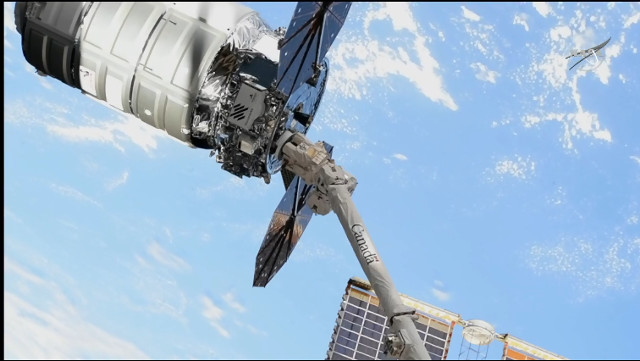
The Cygnus S.S. Piers Sellers cargo spacecraft captured by the Canadarm2 robotic arm (Image NASA TV)

Northrop Grumman’s Cygnus spacecraft, launched last Saturday, February 19, has just reached the International Space Station and was captured by the Canadarm2 robotic arm. Astronaut Raja Chari, assisted by his colleague Kayla Barron, will soon begin the slow maneuver to move the Cygnus until it docks with the Station’s Unity module after about two hours.

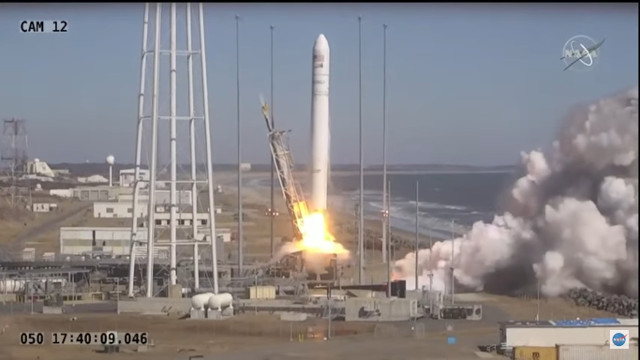
The Cygnus S.S. Piers Sellers cargo spacecraft blasting off atop an Antares rocket (Image NASA TV)

A little while ago, Northrop Grumman’s Cygnus spacecraft blasted off atop an Antares rocket from the Mid-Atlantic Regional Spaceport (MARS), part of NASA’s Wallops Flight Facility (WFF) on Wallops Island. After about nine minutes it successfully separated from the rocket’s last stage went en route to its destination. This is its 17th official mission, called NG-17 or CRS NG-17, to transport supplies to the International Space Station for NASA.